
One of the rubrics we follow at mass at St. Paul's is found in the old Roman missals, but I wouldn't expect to find it in any Lutheran hymnal. Maybe that's because Luther used to express scorn about the monks endlessly muttering the words in a way that no one else could hear. This is a point well taken, of course, but it doesn't mean there's nothing ever salutary about a whispered prayer, especially at mass.
The rubric I have in mind instructs the celebrant and all the attendants at the altar at the moment of elevation of each kind not merely to adore, i.e., to gaze upon the Sacred Species being elevated, and to recognize it for what it is, but actually to whisper, while gazing, the words "My Lord and my God." This, I say, is a wonderful rubric, for it directs the attention of those attending to the truth here: this is the Incarnate One Himself, whom we are about to receive. These, of course, are the words which Thomas spoke to the risen Christ on the Sunday after Easter when he was confronted with the reality of His resurrection and presence.
The same is true at the altar, especially at the point when the words of institutition are spoken: "This is my body; this is my blood." So then, immediately after the consecration of each Kind, the elevation comes; and we whisper, "My Lord and my God." And then we receive Him by mouth, and so receive our Life and Salvation.
The other day I actually heard the server's whisper, and it was a pleasant sound indeed. Sometimes, I can hope, these young men really do seem to get it; they understand what's going on here. Would that such whispers might be heard the world around, and that such quiet, serene faith might abound among all of our churches.
Sunday, October 22, 2006


Thursday, October 12, 2006
A sermon on St. Matthew 3
Holy cow, I didn't even know they were recording it, but there it is, right on Father Petersen's blog, an audio file of my sermon there last month for the St. Michael conference. Some folks were asking for copies of it, and since I don't use a manuscript, I didn't have any. Well, there it is, right online, to listen to. Check it out here.
Thursday, October 05, 2006
Rachel Weeping for her Children
We received news yesterday that our daughter-in-law has miscarried her child, who would have been our firstborn grandchild. While this is not an uncommon thing, it is always especially hard for newlyweds who still await their first child. Nevertheless they, and we, rejoice in hope, in the confidence that our Lord Jesus Christ is especially fond of little ones, whom He blessed and held close to His breast. Behold what a wonderful life this little one has: a life for which Adam was meant, free from all pain and trials of life on a fallen earth. For the angels escorted this child of
God directly to the bosom of Abraham, without the infirmities which befell Lazarus or any of us poor lifelong miserable sinners. No toils or sorrows, no tears, only joy and abiding peace.
As for us who must remain in this vale of tears, we find comfort in the sorrows of our Lord, strength in His weakness, and the promise of life in His death. Ah, who would, then, not depart with gladness To inherit heaven for earthly sadness? Who here would languish Longer in bewailing and in anguish?
Many have sent heartfelt condolances, and among them came this from Fr. Petersen, which I find most worthy of passing along:
I am very sorry for you and yours.
It should not be so. Children should not die before they are born. They should not die at all. One day they won't. One day, the Day of Our Lord Jesus Christ, the groaning earth with stop its lament, the grave will give back the dead, and the revelation of the sons of God will be evident to all stars and planets, rocks and trees, animals and men. We will be free. We will dance and play with the Holy Innocents, and with the miscarried babes of Christian women from time immemorial. Rachel will find the comfort she refused.
Until then we live by faith. We wait on God more than they that watch for the morning. For what we endure is more awful than darkness and night filled with hostility and danger, and what comes with the rising Son is greater than mere safety, warmth, and rest. We are eager for the end, for the completion of what God has begun. And thus we pray: "Come, Lord Jesus, come quickly. Put this sorrow to an end. Turn the hearts of the fathers to the children and put the children back into the arms of their mothers."
Monday, October 02, 2006
TONIGHT, October 2 at 6:05: St. Paul's On the Air
"This is St. Paul’s On the Air: A radio program brought to you by St. Paul’s Evangelical-Lutheran Church in Kewanee, Illinois, where you know you’ve been to church: no gimmicks, no compromises, the talk is straight, and we feast on sacred things. Join us."
St. Paul
The second segment is called "Searching the Scriptures" and will be dealing with Genesis chapter 1 tonight.
The show is already in the can, with a few minor glitches, but on the whole, it's an exciting new venture here. We'll see where it leads.
"If you want to learn more about me or our church, log on at www.stpaulskeweanee.org."
The 25-minute show has two parts, first a Q & A entitled “Why?” which is named after our Sunday morning segment, called “Why,” a question beginning with the word “Why.” So, as I ask during Sunday morning class, “Does anyone have a Why?” The question on the air tonight will be "Why is worship so formal atThe second segment is called "Searching the Scriptures" and will be dealing with Genesis chapter 1 tonight.
The show is already in the can, with a few minor glitches, but on the whole, it's an exciting new venture here. We'll see where it leads.
Saturday, September 23, 2006
Have Gown, Will Travel -- in hopes of teaching rubrics
Actually, I'm only taking a small carryon and a briefcase, due to airline restrictions, but I'm off to a doubleheader this week. First, it's off to the St. Michael Conference, moved this year for the first time from Detroit to Fort Wayne (Redeemer), to do a workshop on the rubrics for the celebrant at mass; and then the next day I wing through Chicago to a second itinerary to Denver, to attend the second annual Augustana Ministerium conference, where I must present a paper/discussion topic on the Historic Liturgy.
Both of these will be opportunities to plug our new St. Paul's Liturgical Institute. We're finally planning to do some hands-on teaching to make up for what has long been a serious deficiency at the Lutheran seminaries. Sorry to make this claim, but it's true. For too long, the bulk of training in how to do the ceremonies has been relegated to 'field work' parishes in the seminary neighborhoods. So neighboring pastors show the students how to do it. How did they learn? In field work, in their seminary days, by neighboring pastors. It gets pretty close to the blind leading the blind, when the seminary doesn't take the lead in these things.
It's been awhile since I've been there, so undoubtedly things have changed a bit, but not nearly enough, from what I hear out of recent graduates. Much more work is needed. Till then, the St. Paul's Liturgical Institute hopes to fill in the blanks.
First seminar, by the way, is in Kewanee, Illinois, from October 20 till November 3. To learn more, log on at www.stpaulskewanee.org (I sure hope the website is running ok; there are bugs in it still), or email me: eckardt@kewanee.org.
Tuesday, September 19, 2006
A Letter to the Editor
To the editor [of the Wall Street Journal]
Brent Stephens’ “Pope Provacateur” (9/19/2006) is certainly a welcome and refreshing rebuttal to the fanatics whose very manner of response sort of proves this pope’s point. In particular I found myself nodding agreement with his highlight of the Pope’s recognition that for Islam, God is utterly transcendent, “not bound even by his own word.” This is also the case, Mr. Stephens notes, for Protestantism. Here, however, a distinction is needed, and the Lutherans’ perennial defense against being lumped with the Protestants might be a particularly helpful ingredient in the faith-and-reason debate. It was John Calvin, roughly the contemporary of Martin Luther, who insisted on the utter sovereignty of God, characterized by a boundless and transcendent will. Pristine Calvinism bears some striking resemblance to Islam in this respect. Luther’s complaints against reason are not to be understood in the same way. His complaint was always against the exaltation of reason above what is revealed. The Pope’s argument sounds similar to that of St. Anselm of Canterbury, with whose famous declaration, “I believe that I may understand” Luther had no quarrel. Indeed when the Pope affirms that God must be bound by His word, he and Luther begin to sound very much alike. When God is divorced from His word, whether by Christians or Muslims, the danger of fanaticism always looms nearby. Since Calvin never saw that utter divine sovereignty and divine mercy were incompatible with each other, his thought never reached the radical stage of which it might otherwise have been capable. With Islam—although it certainly has its moderates—there is no mitigating notion of divine mercy at all to offset a transcendent and untethered divine will. The result can easily be, understandably, a very unruly mob of people. They’re acting the way they believe their God is capable of acting.
Monday, September 18, 2006
They're Here
Well, I knew this was coming. I told you so. We now have women ministers in the Missouri Synod. We just don't know it.
Here's how they did it. For the past thirty years, we've had the notion drummed into our heads that you can't ordain women, it's against the Bible, etc. So the SOW* folks decided to change their tactics in order to get the women pastors they always wanted.
Step one: convince everyone that ordination is an adiaphoron, an indifferent thing. Never mind that the Lutheran Confessions permit you to call it a sacrament, it's nothing more than a nice apostolic custom which we are free to take or leave. By the way, to any idiot who wants to retort that the Confessions do not require us to call it a sacrament, I'd like to say that I dont require it either: but in permitting such a designation, the Confessions are at the least affirming that it is an act of God. I wouldn't want to call an act of God an indifferent thing, would you?
But the SOW* crowd accomplished the first step, and now synodical types everywhere are convinced that ordination is really an adiaphoron, in spite of the fact that the Church has never designated someone as a minister without it.
Step two: reintroduce the historic diaconate, something the Synod should never have abandoned in the first place. I remember the haughtiness of the committee at the last convention which, when asked to consider an ordained diaconate, declared, oh no, ordination is a term reserved for pastors. Sure it is: as of 1853 in our synod alone. Talk about parochial!
Anyhow, now deacons are popping up here and there without ordination, and in fact the duties of a deacon, given for example in the Mid-South District, are pretty good ones (for which click here). Only trouble is, they're not ordained!
Oh, and this: there are females among them! Want to see one? Just check out the Mid-South newsletter, click on July-August, and go to page five (thanks to Fr. Larry Beane for the heads up on this). So now you have what I knew you were going to get: women in the ministry, women preaching, women administering the Sacraments. But it's all OK, because they're not ordained! You synodical types will just never get it, will you? You've been duped into this, and you never knew what hit you; the SOW* crowd can just give a quiet aside to its members: don't worry, ordination is no big deal anyhow. After all, we can even arrange for you to get your holy tax break, like we did for our "commissioned ministers"!
Now instead of this nonsense, can we please get serious about having a proper diaconate, complete with proper ordination? Like I said, they have a very nice explanation of what a diaconate does (and, unintentionally, why it should be an ordained diaconate), which, once again, you can see if you click here.
*Synodical Organization of Women, which actually doesn't exist as such, but is definitely a crowd of people who think the Biblical mandate against women preachers doesn't apply to them. They, like the NOW crowd, seek to impose their brand of feminism on the rest of us.
Wednesday, September 13, 2006
Octoberfest is Coming
Announcing . . .
Octoberfest
At
Sunday afternoon and Monday, October 8-9, 2006
Conference theme: Arranging Everything around the Blessed Sacrament of the Altar
This year we hope to have presentations by as many of the Gottedienst editors, live and in person, as we can get. Our editors include Dr. Burnell Eckardt, the pastor of St. Paul’s, who is the editor-in-chief, Dr. Karl Fabrizius, Rev. Aaron Koch, Chaplain Jonathan Shaw, Rev. John Fenton, and our newest associate, Rev. David Petersen. We expect most if not all of these men to be on hand to speak to participate.
The two-day event begins on Sunday afternoon at 5:00 p.m. with Autumn Choral Vespers, followed by a bratwurst banquet and awards ceremony (actually a bit of horseplay . . .). Monday’s schedule begins at 9:00 a.m. and includes Holy Mass at 9:30, followed by a series of seminars on the Sacrament and its centrality in the life of the Church. The day’s events end with Vespers at 3:00 p.m.
The conference fee, which includes three meals, is $25 per person, $40 per couple, or $15 per student. Children with parents free.
For more information, call (309) 852-2461.
Lodging: AmericInn,
Aunt Daisy's B & B, 223 W Central Blv.d. 888-422-4148
Kewanee Motor Lodge,
Super 8 Motel, 901 S Tenney (Rt 78). 309-853-8800
Days Inn, I-80 & Rt 40,
Directions:
To register, you may send us an email (Eckardt@kewanee.com)with the following information:
Title
Name(s)
Wife’s first name if applicable
Address
Email
Phone
Church
Sunday and Monday or Sunday only or Monday only
You could also reply to this blog and let us know, if you want, if you don't mind everyone in the world knowing that you're coming. But why not? It might encourage them. Then again, if you're shy, just send us your data as I suggested in the first place, in a separate email.
Saturday, September 09, 2006
Man's Best Friend

We finally did it. After a twelve-year hiatus without a dog, we have now increased our family size by one canine. We've had a fine cat in the intervening years, whose objections to this new brother are actually not as fierce as we might have expected, but I must say I disagree with Robert DeNiro's character in Meet the Parents. He said, as you may recall, that cats are better than dogs because they don't sell out, they make you earn their affection. Maybe so, but the thing about dogs is that they are loyal, as everyone knows. You can be the ugliest, craziest, or most neurotic, hated, or odd person in the world, and you dog will still love you. A dog's love is pure grace. I guess that's what I need.
So anyway, this little Labrador-retriever puppy is only four months old, and we're pondering a name for him. On top of the list right now is Reggie (the boys like this one, for Green Bay legend Reggie White). My favorite, Wyatt, was nixed. Also rans included Brett, Vince, and Lambeau. I would have liked Herb (my favorite Packer was Herb Adderley, back in the day). We also considered Luther, but that's a bit too common among Lutheran pastors. Also Bach, Mozart, and Johann. I sort of liked Laphroaig too, or Islay, or Malt (he is a brown dog), or simply Scotch. But I guess that would be better for a terrier.
Anyone with ideas may submit. We still haven't decided.
In other news, we have learned that we are to become grandparents sometime in late April or early May. Forgot to blog about that the other day. I guess that shows how much I am into instant gratification. Like, we have a dog right now, and the baby is still a ways off.
Thursday, September 07, 2006
A Double Life in the Blogosphere
I just spent a little while surfing through various blogs. Man, I am behind the curve. They're everywhere, and they are multiplying faster than rabbits on enzymes. Some of the blogs I saw are sharp and witty, and had me chuckling, thinking, gee, when I grow up I want to blog like that. The links are helpful ways to get you from blog to blog, but they can also blow you away, when you begin to see what looks like a vast blog-wing conspiracy seemingly seeking to take over the universe. There are blogs for everything. Naturally, I especially liked the one I ran into debating the virtues of Ann Coulter (she's my girlfriend, according to my dear wife, who seems to be all right with this).
What I find somehow stupifying is that there seems to be a lot of time and effort going into these blogs, some of which are updated daily. This is a veritable Phoenix which has arisen from the ashes of ruined newspaper empires. There must be millions who are writing and reading blogs. Reading too, because of the comments that get attached to the posts. Hey, is anyone reading this one? Ah well, I have been known to talk to myself on occasion.
So anyway, I'm wondering just how much time people are spending at this stuff, and I'm thinking maybe it's way too much. Or is it? The jury is out, I guess. On the one hand, it's so much fun to sit in front of the screen and type away, and not have to deal with life's real issues. It's a great escape, and in a certain respect one can easily live a double life in the blogosphere. I guess everyone knows there's cybersex too for those who want it, and nobody has to know. What a convenient place is the blogosphere for vices of all kinds, from the x-rated kinds to the garden variety, which, while tame by contrast, can be plenty harmful. Sloth is one the deadly sins, after all.
On the other hand, I suppose blogging can be a very good thing, as it's a means to reach people's minds and engage them in conversation. The blogosphere is very large. Anyone from Australia reading this? Or Siberia? Or the planet Pluto? As is usually the case with vices, the vice of overblogging is the abuse of a good thing.
And wouldn't you know it, here I go, spending too much time at this already. See how easily one can get carried away?
Tuesday, September 05, 2006
Something Missing?
Today I read an article about how the Pope went to see Veronica's veil, supposedly kept in a village about three hours from Rome. As I read the account, from a Roman Catholic source, I noticed the usual sense of wonder over miraculous things meant to verify the Christian faith. It is now thought by some that this 'veil' may not be the veil with which Veronica wiped Jesus' face as He was on the via dolorosa, but the headcloth, or "sweat cloth" found folded separately from the shroud in the empty tomb on Easter Sunday. There are some compelling data about the veil which contribute to the possibility that it is genuine, and yet, as is the case with most artifacts and relics the Church of Rome maintains, a thread of sensationalism running through the report. It's almost as if they're wanting these things to be true to bolster the Christian faith.
On the other hand, when I finished the article, I turned to some current events and doings among Lutherans, and I saw a completely different approach. Here, there was no concern at all about matters which have a direct connection to the life of Jesus, the matters reported in the Gospels, but rather, an abundance of emphasis on 'reaching people', evangelism, spreading the 'gospel', etc.
And I think that somehow, the attention given to relics and artifacts, while often bordering on superstition, is better, nevertheless, than attention given to 'sharing your faith'. The latter is too often subjective, personal, and devoid of any real Gospel content.
While certainly it is possible--and even laudable--to take the opportunity given to 'tell someone about Jesus', the emphasis on this telling has reached such a fevered pitch that, ironically, little about Jesus ends up being told at all. Rather, passing reference to who He is and what He has done might be made, while the heart of the telling is usually the invitation to receive Him, or to accept Him into your heart.
It's easy to criticize Rome for its superfluity of relics and superstitions. But I must say that there does seem to be at least a grain of goodness, if only a small one, in paying more attention to things which actually bear a better connection to Jesus than my own personal experience of His presence in my life.
Wednesday, August 30, 2006
The Shriven Woman
Tonight I'll be preaching on the Gospel from St. Luke 7, so I'll muse about it a bit in print. This woman kisses Jesus' feet and washes them with her hair, because she loves Him. She loves Him because she was forgiven much, as He says. So the false religion of this Pharisee is exposed. See, he had invited Jesus to dine with Him, no doubt because Jesus' high esteem among the people would likely help the Pharisee's own esteem with them. So it is with many who call themselves Christian yet know nothing of associating with sinners, to say nothing of repenting themselves. The Pharisee's indignance likely showed on His face, for when we are told that Jesus gave answer to what he was saying only within himself, we need not suppose that our Lord was drawing on His omniscience to know it; it was surely evident. There's a wonderful renaissance painting of this scene -- it might be a Rembrandt -- which shows the pomposity of the rich Pharisees decked out anachronistic nineteenth-century attire, while this poor ragged woman crawls up to Jesus' feet in their midst, making all the dinner guests uncomfortable. How little she has regard for appearances, thinking only of the overwhelming fact that she is in the presence of her Master; but how much they regard appearances, thinking so much of them that they miss the wonder of this occasion: their God is visiting them here, but they are too busy being indignant to notice.
Let all beware of false piety, and of keeping up appearances for their own sake. And let us follow the example of this public sinner, this harlot. She is unquestionably Mary of Bethany, as we are told in St. John 11 where this occasion is connected to Jesus' visit to her home. And when Jesus on another occasion visited Mary and Martha, it was Mary who sat attentively at Jesus' feet. This is not because she wanted to come off as pious, but just the opposite. She was utterly taken with Him, absorbed with Him, and her cup overflowed.
So must we all learn to be. Repent of false piety, and find your place on your knees before Jesus' feet. Wash them with your tears and wipe them with your hair; place yourself meekly beneath Him. For He forgives sins, another thing the Pharisees could not abide.
Become like Mary, then: close out the world and its Pharisaical masks. See only Jesus before you, and be overwhelmed: your God is He, claiming you, shriven sinner, for Himself, and forgiving all your sins.
Thursday, August 24, 2006
A Priestly Blessing
 I trust Father Hollywood won't mind if I paste his belated reply to an earlier post here, as I find it most helpful, and something with which I heartily concur. Father H., I like the way you think:
"I realize this post is delinquent, I had meant to chime in earlier. A benefit of living in a heavily Roman Catholic area is that people seek out the blessins of the clergy. They "get" just what you're saying about the priestly blessing and the authority given to Christ's ministers.
"Strangers will come up to me and ask me to pray for them and bless them - even with my wife and son in tow (obviously, I'm not a Roman priest).
"This happens even more frequently when I'm in a cassock. To those who think the 'adiaphora' of clerical garb is useless, or even worse than that, negative - you need to put on a cassock and stroll around the neighborhood.
"Big guys with tattoos and little old ladies will come to you with pained looks on their faces and ask you to give them the blessing of the Lord Jesus - whom they know you represent and in Whose stead you stead.
"That's evangelism without a program, slogan, balloons, or even the letters 'TM' in fine print. "
Amen to that.
Monday, August 21, 2006
A Must Read
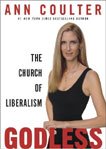 Say what you want about Ann Coulter, this latest book of hers is right on the mark, besides being an entertaining and fascinating read. No wonder the Left hates her so much: she is unafraid to call a thing what it is, and she does it with matchless wit and sauciness.
The reason I likewise am unafraid to recommend Godless: the Church of Liberalism is that it is not so much the reflection of a particular political stance as it is the exposing of scoundrels whose true aim seems to be the destruction of what is good (even of life itself, as in her arguments against the abortionists), and the rejection of the Creator (as in her case against evolution). This is not really a political book; it is true to its title, and it makes its case with remarkable skill.
And it does so with a flair which leaves no one wondering if Miss Coulter isn't just another fundamentalist bent on denouncing immorality for its own sake. She is too sarcastic and funny to be one of those; yet she argues with an aptitude which reminds me that she was once a lawyer by trade. She is a veritable Xena with words; even the New York Times has had to admit as much.
The first half of the book is methodical in its demonstrations of its claim that the Left is godless, so thorough that it left me feeling rather like St. Anselm's interlocutor blurting out that there is no possibility remaining of anyone issuing a rejoinder. Miss Coulter clearly subscribes to the doctrine of employing overwhelming force against the enemy, at least in literary terms.
About midway through the book she takes her case into the classroom, and proceeds to take on the myths promulgated by the behemoth teachers' unions in America. But this in itself provides a segue into the last, unexpected half, in which she dedicates several chapters to dismantling the myth of evolution.
She joins a host of recent writers who have begun to take on the scientific community's most basic Darwinian assumptions. In effect, the Scopes monkey trial is being revisited in our day. In fact, she exposes in particular that trial as the publicity stunt that it was.
But Miss Coulter is no slouch: she provides a tremendous amount of research and support for her claims, which is especially significant when she makes her case against Darwin and his heirs. And there is a difference between the way she battles the evolutionists and the way the fundamentalists have done so. She battles them on their terms, and exposes their tactics, while at the same time revisiting the case for Intelligent Design, unafraid to take on even a recent op-ed in the Wall Street Journal.
And she is not, contrary to popular belief, merely the conservative movement's answer to Michael Moore. Or if one insists on making the comparison, then only insofar as one can compare high class and savvy to juvenile follies.
But no mere reviewer can really make this point stick merely by saying it, which leads to the chief assertion of this review: Godless is a book that deserves to be read, by friend and foe alike. Anyone who chooses not to do so with a dismissive wave of the hand, as if to say, "Oh, that's just Ann Coulter, after all," has no business arguing against her case.
Wednesday, August 16, 2006
Back from Idaho

We're back from a fine vacation in Idaho, and I expect to be posting soon. One thing I mused on while seeing gorgeous tree-blanketed Rocky Mountains was this: These mountains must have been created by the Flood, in one day. The continents shifted west and caused the backwash of oceans to make a mountain range all along the west coast right down to the tip of the Andes. So the jagged edges of rock so prevalent there are a reminder of God's power and wrath. But the fact that many of them are now covered with trees ought to be a reminder that the wrath of God has now subsided, even as the flood waters themselves did. Indeed, what better natural symbol of mercy could there be than a tree? As the hymnist Fortunatus said it, "Faithful Cross! above all other, One and only noble tree! None in foliage, none in blossom, None in fruit thy peer may be. Sweetest wood and sweetest iron! Sweetest weight is hung on thee." So the image portrayed to knowing eyes by tree laden mountains is this: God's wrath has been put aside by the cross of our Lord Jesus Christ, and mercy abounds. No wonder the scene is so idyllic and calm.
Wednesday, July 19, 2006
One Voice for the Our Father
When in the old tradition of the Mass the Celebrant chanted the Our Father alone, he was not only following a venerable tradition which dates to the Early Church--which ought to be reason enough to retain this noble practice--he was also serving as bishop, the symbol of the unity of the Church. It is the same as when he chants the Collect alone (which, by the way, he should also do alone, especially in the Mass). It is called the collect because it is the prayer of the collected faithful: the many become one, expressed by the one mouth of the bishop.
Similarly, the Our Father is a prayer in which the many become one. The celebrant speaks for all the people, he performs a priestly duty here. But more importantly it is a Christic duty; in performing this duty he is serving as Christ for the people, presenting their petitions to God out of his own mouth.
After all, what gives us the right to call God our Father? Is He not the Father of Jesus Christ? And is not Jesus the only-begotten Son of God? God has no other children than Christ: he is the only. Then how is it that Jesus bids us to call God our Father? Surely, this can only be properly understood as an invitation for us to pray in Christ. We pray this prayer to God as though we were Christ Himself, for we are in Him. Heathen cannot rightly pray this prayer. It may not be prayed by one not baptized. This is why the pastor lays his hands on a child presented for Baptism, during the Our Father: it is an indication that the Our Father is here, in Baptism, being given to this candidate as a gift: he is being incorporated into Christ. Now, having been baptized into Christ, he is privileged to call God Abba, Father.
When at the High Feast of Salvation this principle is most properly expressed by the celebrant's utterance of this prayer alone. All Christians say this prayer day by day; but at the Altar, where the many become one, so the prayer fittingly becomes uttered by one voice, the voice of Christ. Christ employs the mouth of His servant, the celebrant, but the voice is most certainly His own. And thus all the people pray this prayer as one.
And it is said in immediate proximity to the Verba, the words of Institution, spoken also by the celebrant alone, in the stead of Christ.
Adapted from a 1999 article. Father Eckardt will be on vacation until mid-August. Comments will not be answered until then.
Monday, July 17, 2006
Wednesday, July 12, 2006
What's so Golden about the Middle?
It has become fashionable for church bureaucrats to instruct pastors with whom they have to do that while whacky, out-of-touch, loony "liberals" with their antichristian agendas are certainly not to be tolerated, there are also those who are too far out on the other side. The implication is that the middle is golden.
This is certainly true of some things. But the fact that it is gives no license for the maxim to be applied to all things.
There are not always two fringes.
Are we to say that someone who is way out on the 'no-integrity' fringe is no worse than someone who is way out on the 'too-much-integrity' fringe? Or what of someone who lies all the time. The other fringe would be someone who is too truthful. The reductio ad absurdem is not too hard to find.
So too, while there is certainly a too-loose fringe in matters of worship, that is, a kind of worship in which anything goes, and in which therefore everything becomes objectionable for those who truly want Christian worship, must there necessarily be a corresponding too-rigid fringe? "Rigid" of course is a nasty term by which bureaucrats like to refer to liturgists who take matters of worship with all gravity and seriousness. But is there a too-tight fringe? Actually if it be a truly opposite fringe to one that is too "loose," we must define "loose." I rather think it means casual, or lacking formality. But what's formality in worship? Is it not synonymous with reverence? Can one be too reverent? Ah, that is the real matter. Too reverent?
As in, have we shown Christ (whom we believe to be present) too much deference? Too much adoration? Too much worship?
I'm not sure the reference to the lukewarm in the Apocalypse is meant to apply to this, but I'd say it sort of fits. Sometimes the middle is not so golden.
Thursday, July 06, 2006
Blessings?
One of the more amusing clichés which has evolved in recent years is that now-ubiquitous sign-off now used by many a clergyman, whether in print or in person: “Blessings!” Most commonly the expression begins “Blessings on your . . .” To this is added a word fitting the occasion. So to a pastor one might say, “Blessings on your ministry,” or to a committee, “Blessings on your conference.” To a pastor about to preach, “Blessings on your message” is heard. Or often the word stands alone, as in correspondence, being a closing salutation.
Whence this came is anyone’s guess, but what this historian finds amusing is the fact that it’s so often used by the kinds of Lutheran clergy who at the same time hold tenaciously to an acute anti-Catholic bias. They won’t wear a chasuble or intone the Introit, because that’s Catholic, but they’ll dispense blessings more freely than the most Tridentine of priests!
Among traditional Roman Catholics, the blessing of the priest is eagerly to be sought, and taken quite seriously when obtained. People would approach a priest for no other reason than to ask a blessing on their children (though not, I might add, while kneeling beside their parents partaking in the Sacrament of the Altar). The Vatican magisterium has routinely taught that a solemn duty of the priest is to dispense blessings upon his people.
I am, to be sure, rather vaguely averse to the usage, but not because of this. If anything, the thought that if taken seriously this cliché might offend against the anti-Catholic bigotry in our midst (one of the last acceptable forms of bigotry left in current society) would lead me to find it more, rather than less, palatable! I think Lutheran ministers would do well to consider the dispensing of blessings to be a solemn duty they too ought to do. These can take the form of brief benedictions when meeting with the bereaved, the sick, the distressed, or anyone who comes to meet with them. It ought to be done with the laying on of hands and signing of the cross on the forehead (and perhaps even with chrismating oil, as St. James says). In fact, the thought sits comfortably with me that this is really what is going on at the confirmation ceremonies of our young. The young teens are simply receiving the blessings of their priest as they enter adulthood. We already treat Lutheran confirmations as a sacramental kind of thing, even though we insist that confirmation is not a sacrament. But we routinely have parties whose celebratory mood can rival that of any bar mizpah or quinceñera. These youngsters are simply debutantes of a kind. Fine. So we do it in church, give them the blessings of their pastors, and think those blessings sort of sacramental, in a way. Perhaps a fuller consideration of this would be a fit topic for another day.
Regarding blessings in general, let us take them more seriously than as the bland, vanilla blubbering which the term “blessings” has come to be. Taken as it currently is, I would submit that to those who hear it, at best it generally communicates absolutely nothing, and at worst it gives an indication the one saying it must be a very holy person, that he speaks such a holy word. The latter inference is of course particularly odious to faith, because it smacks of the worst kind of pharisaism.
Let Lutheran ministers take the dispensing of blessings to be a solemn duty, then: they were ordained to do this, certainly, as Jesus said, “He who hears you hears me.” But let them never think that this can as well be something they ought carelessly dispense, in effect attempting to raise the estimation of others as to the degree of their holiness.
Adapted from a 1999 article.
Wednesday, June 28, 2006
Subduing the earth
At our house we've been working on the biggest project in family history. We're remodelling the bathroom, and since I'm a poor preacher (or so they tell me), it is necesssary that I learn to do as much of it as I can by myself. So in my spare time I've been a carpenter: tearing walls and floors apart, removing old tiles, old shower, old sink, etc.; building new structures here and there, putting up insulation, drywall, and cement board. We have a contracter working with me, but I've been doing things alongside of him every step of the way to reduce his hours of labor. We're finally to the point where most of the new light fixtures are in, new electrical, some new plumbing, new shower, new tub, new sink, and now stone tiles for the countertop and floor are going in. Soon we'll be finished.
Every night I go to bed sore, and wake up stiff. What a way to get in shape.
As I was mixing mortar today, I got to musing on the fact that this is what man does: he fills the earth and subdues it. He makes things do what he wants them to do. He puts them in order, by the sweat of his brow, even as Christ did in our redemption.
Jesus was a carpenter. That isn't just an interesting point of trivia. It means he was raised by Joseph in the trade of subduing the earth. This was a token of the redemption he would work.
Some say that the most godly places on earth are serene natural settings: sunsets, glaciers, canyons, mountains, etc. I think not. Raw nature can be beautiful, to be sure, but it generally needs to be tamed. It needs man. The most godly place on earth, therefore, has to be a place which man has crafted from the raw materials of earth. The most godly place on earth is a temple.
Destroy this temple, said Jesus, and in three days I will raise it.
The resurrected Christ has subdued the earth. It's something to appreciate when you're in the midst of a remodelling project.
Monday, June 12, 2006
Preaching and His Word
O preachers, it is written that the fear of the Lord is the beginning of wisdom.
That is, do not think yourself wise if you think that the beginning of wisdom is within you. Do you hold the Sacred Scriptures in the highest regard? Do you really believe them to be God’s Word? That all matters of faith and confession are to be answered by the Scriptures? Is Sola Scriptura your motto? And your preaching Bible-based and Christ-centered?
Then do not say that the Word of God needs to be made relevant. Do not they think of yourself as the filter through which the Word of God becomes relevant, something that the people can relate to, something they can take home with them. Do not think the sermon becomes the making relevant of the Word of God, putting it into terms we already understand. Do not make the preparation of a sermon an exercise in taking something from Scripture and using it to launch into something else, something you find easy to hear. So, for instance, a sermon on the multiplication of loaves and fish for the four thousand, ought to be more than a discourse on how able Jesus is to provide for our needs. The details are not to be omitted or ignored, or deemed insignificant. Take notice of the fact that the loaves and fish were brought by a boy who seems to have more faith than the disciples do. Consider how Jesus says to make the men recline where there was much grass, a link to the Twenty-third psalm. In short, do not preach something you find in the shrine of your heart to preach. Rather, preach something you have found in the words of the Gospel themselves.
If men would become true preachers of the Gospel, whose preaching they expect others to hold sacred and gladly hear and learn, they must learn how it is that their preaching will be in truth the very Word of God. It will not be if it is only something they themselves have dreamed up and hoped would be relevant. Rather, it must be something to which their hearts are held captive, which they have learned upon a musing on the sacred words themselves. For in this musing the Holy Ghost is present, as Luther also said.
But this will never happen among those who presume to know better than the words upon with they preach. Who for instance might find it too dangerous a thing simply to say, “If your right eye causes you to sin, pluck it out and throw it from you,” for they worry that someone might take them literally. What? They don’t think Jesus thought of that? They know better than He about what might be an ill-advised thing to say? Or again, they might find it too immodest to preach those texts which happen to refer to the breasts of a mother. That might be too embarrassing. Or they might think it too violent to preach about the bloody texts of murder or its vindications. What would the children think? Or—here it gets really dangerous—they might think themselves too loving to preach the imprecatory psalms. So what do they do with them? They simply ignore them, ignore those words of the Holy Ghost. For they know better, they are wiser than that, they know their people, and they know what might be offensive to them. So they say. And thus, beginning in ever so innocent a way, they listen to the shrines of their hearts over the written revelation of God.
O preachers, rather, be captive to that Word, not only in a general sense, but in very specific ways. If Scripture rebukes, you must rebuke; where Scripture becomes graphic you must be graphic; when Scripture is frank you must be frank.
Yet on the other hand, do not be more so than Scripture. Do not speak openly about shameful things which are done in secret; do not attempt a shock treatment on their hearers with a load of terms and descriptions Scripture does not use, especially when dealing with matters pertaining to sexual conduct and thought. Here, Scripture uses circumlocution very consistently. Thus, so must you. Though Scripture may be graphic about the battlefield, it is never graphic about the bedroom. You must follow suit.
You must, in a word, follow Scripture. You must not employ Scripture—Scripture must employ you. You must muse on the Scripture you are preaching, search it, rather than simply musing on what you might be able to say about it from your own resources. You must hear the Scriptures preaching to you first, and only then will you be ready to preach the Scriptures. You must regard especially the words of Christ as His sermons to you, and then when you yourselves preach, you will be preaching His sermons, His Word.
Simply, submit to His Word and fear it with a holy respect and reverence; that is the beginning of wisdom for preachers.
Adapted from a 1999 article.
Monday, June 05, 2006
A Meditation on Pentecost
According to Moses, Pentecost was observed by the bringing of new offerings, on the fiftieth (pentecoste) day after the day after the Sabbath following the Passover. So Jesus (our Passover) instituted the Holy Sacrament at twilight before His crucifixion, rested in the tomb on the Sabbath (Saturday), and rose from the grave on the day after. Fifty days later comes Pentecost on which a new offering is given, that is, a new age of the Spirit inaugurated. Today Christ's promise to His disciples is fulfilled, as the Holy Ghost, the Comforter, is sent to them, and they begin to declare His peace to the nations assembled there, on the fiftieth day from Easter. Pentecost, for seven is creation=s number, and forty-nine is creation squared, creation fulfilled; fifty then begins the age of the new creation. Sunday, because this is the third and final great Sunday of history, Creation Sunday being the first and Easter Sunday the second. So on Pentecost Sunday all is fulfilled, when the Spirit begins to give life to the Church through apostolic preaching.
--Burnell F. Eckardt Jr., Every Day Will I Bless Thee (Sussex, Wis.: Concordia Catechetical Academy, 1998), s.v. The Feast of Pentecost. To Purchase this book for $21.00, go pages 2-3 of the online catalog for the Concordia Catechetical Academy for ordering information, then click here for their printable order form to mail in your order (their online bookstore is currently under construction).
Saturday, May 27, 2006
Why I Let My Yes Be Yes: a Soliloquy on the Sacrament for Memorial Day
The non-alcoholic wine debate still rears its ugly head from time to time, centering on the question whether non-alcoholic wine or any other substitutes could be permitted for use in the Sacrament. At times I have found myself engaged in a exchanges in which I found it necessary to defend things which ought to be beyond question among Lutherans.
One such exchange took place in a little tete-a-tete I once had with a proponent for the use of grape juice. It was at an open hearing of a floor committee for a district convention of the LCMS. The meeting room was far too small, as the floor committee saw a great multitude in attendance. The walls were not visible for the flesh that lined them, and the summer heat was no ally to that flesh. I arrived about ten minutes after the hearing began, so with a number of others had no place to sit. By this default I ended up standing in a highly visible place right behind the chairman's seat, and listened as the arguments for and against non-alcoholic wine were heard. On the one side of the debate were those of confessional acumen and concerns who pleaded for the maintenance of right administration of the Sacrament in accordance with Augustana VII, on the other side were those who contended for what they called the need for love and understanding in dealing with difficult situations with alcoholics and the like.
In the midst of all this there was a certain layman among the latter, who gave a long, passionate speech about his days in the service in the Korean War and World War II. He spoke with feeling about the 9,000 soldiers who lost their lives fighting beside him at Omaha Beach. Before they went to their final battle, these men all received "communion" from the chaplain, who, due to scarcity of resources, did not have enough wine. But he did have grape juice (why this is so, no one asked). So grape juice they all received, and went on into battle, and lost their lives. At this point the man asked for a pastoral reply to the question he posed: "Do you mean to say that those men did not receive the forgiveness of sins?"
It was then that I opened my mouth, and gave my reply which raised and rankled more than a few eyebrows and feathers respectively. I said but one word, which all in the room clearly heard, and which for its piercing simplicity shook the very foundations of that chamber: Yes.
That was my pastoral reply.
At once another man lunged at me, crying out angrily, "Lawyer! Pharisee!" The committee members, thankfully, were livid against this name-calling, insisting that it stop.
Debate continued in that crowded room until finally there remained time for one more speaker, and the chair yielded to me.
"I must tell you," I began my defense, "that it was I who got this whole mess started, for I am the author of the resolution in its original form. I wrote it against non-alcoholic wine; but I certainly never expected such a brouhaha to result, and I cannot even recount for you all the names I have been called since I brought it up.
"It has occurred to me, however, that the reason there is such passion over all this, is possibly a failure to remember a crucial distinction, which Martin Luther so clearly made in his Galatians commentary. I know it by heart, for it is very important to me. Luther carefully distinguishes there between faith and love, and warns against forgetting the distinction. Love, says Luther, always gives in, always lets others have their way, always gives place. Love bears all things, believes all things, hopes all things, endures all things. But not faith. Faith will not stand for anything. When it comes to faith (says Luther) I want to be stubborn, and to be known as someone who is stubborn. Faith will not yield the least little bit. Here is where I side with Luther, then, and say the same, that I too wish to be known as someone who is stubborn about the faith.
"For this matter runs to the heart of the Gospel. Certainly those 9,000 servicemen who died were either saved or not, depending alone on their faith in the Gospel. But at that moment, when that chaplain gave them that grape juice, they were not receiving that forgiveness. This is why this matter is so critical. This is not lovelessness or legalism. It's the very opposite; for this has to do with Christ. Those servicemen needed one thing there on that battlefield, for their confidence and comfort in time of trouble, and no amount of good intentions (with which the road to hell is paved) could give them what they needed. They needed Christ whom they believed, but the chaplain did not give Christ to them.
"It's really very simple, and I plead with you to listen to me now: If you change the elements of the Sacrament, you don't have the Sacrament, and if you don't have the Sacrament, you don't have Christ."
So ran my reply.
On the same day there were some who expressed concerns with that original retort of mine, that “yes”; not, that is, with its substance (though indeed many were quite opposed to that as well), but with its fittingness in that time and place, the simplicity of it. No, I was told, that turned people off, made them unnecessarily angry, and could have been expressed otherwise. I was at that moment too harsh, some said, and that was wrong.
Now I admit to having thought about this long and hard myself. Was that “yes” too much? Should I have let the rhetoric pass unanswered? Could I perhaps have done more through a more winsome approach, something less barbed? Was that answer less than pastoral? Now clearly it would be easy for me simply to say that it was, and admit a lapse of self control there. Strangely, however, my conscience, which is so often a noisy gong in my ears, was quite silent and at peace.
The reason I could admit error there is that I came to the conclusion not only that I did not err, but also that very much more is at stake in this matter than any admission of my personal wretchedness, of which I am always well aware. Certainly (because of that wretchedness) I am one who can easily fall to the desire for vainglory, and certainly also from this to self-aggrandizement in the eyes of my peers. But here I must divide and distinguish sin from faith; for though I sin, yet do I believe, and further believe that in that assembly “yes” was absolutely required, notwithstanding any sin which may have attended it. It is when I consider the alternatives carefully that this becomes most clear.
To have said nothing would not have been the way of faith; this is not to say it was necessary that I be the one to answer, merely to say that faith must answer this question; somebody had to answer, lest through silent acquiescence on the part of all the gainsayers make disciples and, as it were, Goliath taunts the armies of God unanswered. What figures more importantly in the rejection of this option, however, is faith's simple necessity of making confession.
There are times when a clear confession is called for, times when men of faith must say, "I believed, therefore have I spoken." Such speech comes not from reasoned considerations of effectiveness, nor cautious regard for winsomeness. Indeed the word sprang from my lips before I gave a single thought to the effectiveness it might have. I simply knew it needed saying, at once, before the opportunity for saying it passed by.
But one might as well say this was not the time for such confession, that this was not the place for true theological discussion, for the room was too hot and crowded, and passions ran high, etc. To this I would reply that these kinds of circumstances are not in themselves prohibitive of confession. If they were, then not only would every man who spoke well that day have been out of place (and there were a great many who spoke well for the faith on that day and in that place), but even Luther's famous confession before the Diet of Worms would have been out of place. For Luther's confession was likewise in a small upper room which was so full of officials that crowd control became necessary; indeed emotions and tensions ran so high that pandemonium broke loose there following Luther's confession (see Schwiebert, The Life and Times of Martin Luther, 501-505). When tempers or passions are inflamed, certainly it is more difficult to make reasoned judgments, but the increase of difficulty in itself cannot justify the shutting of confessional mouths.
Moreover, and most importantly, if this was not the time for such confession, when is the time for it? The Church is not of the world, but she is in the world, and she is required to make her confession before men, as our Lord Himself declares. Reason, whom Luther was wont to call the devil's greatest whore, cannot be trusted to determine the circumstances most fit for such confession. This must be left to faith, and faith must be left to itself to make such judgments. Faith, molded and led by the Word, employs that Word in confession when and where it wills, and is alone fit to determine when to speak, especially in the heat of battle. Faith employs reason in this regard, to be sure, but reason cannot question faith, for faith knows more than reason can fathom.
Thus I conclude that it was fitting and meet for faith to speak there and then. But what would faith say?
The question itself wanted a simple yes or no answer. Did those 9,000 receive forgiveness at Omaha beach? Here we must consider the enemy's treachery. How perilous is the ground of this battle, where the enemy vies for the hearts of the careful hearers witness to that debate.
What if I had said “no”? What would it have meant? Here the enemy could have taunted the people of God. Aha, aha, he could then well have sneered, your insistence on right administration cannot stand here! See, you answer “no” to my question, so you must admit that I am right, for if those 9,000 received forgiveness there, then why have you made such an issue of this matter? How can you make such a big thing out of such a small thing as this? For they died with forgiveness, the one thing needful.
But did they? One could (with the sophists) determine that even though they did not receive forgiveness with the cup, yet they did with the host, which was bread, and hence also the body of Christ. But this skirts the true question, which in the first place was not asked concerning the host but the cup, and in the second place was in substance asking whether changing the elements affects the giving of forgiveness through them.
But what about the Word? Could we not say that they certainly did receive forgiveness with the words of the Gospel spoken then and there over the elements? Is it splitting hairs to say that forgiveness was not received in the cup as well as with the cup?
Here we have come to the very heart of the matter. For if forgiveness was thus received, the very Sacrament has been robbed of its essence. The words of the Gospel tied to the Sacrament are these: This is my blood . . . shed for you. It is true that Christ's blood was "shed for you", and that that is itself the Gospel; yet these words now come in a declaration that makes this, namely this cup, meaning by circumlocution the wine in this cup, His blood, "shed for you." Thus in the Sacrament we say that this cup is that blood, and recognize that the Gospel itself is placed nowhere else than in this cup. Therefore to alter what is in the cup is to remove the Gospel from it, and hence also forgiveness.
But surely, one might still protest, you do not mean to say those 9,000 servicemen died in their sins. To this I reply with Luther and Augustine that certainly faith's desire for the Sacrament is in itself sufficient: "only believe," they both declare, "and you have already received the Sacrament."
But what did they believe? That the blood of Christ was under the grape juice? Here I must sincerely hope not, for this is not the substance of faith! Faith has no word of Christ here upon which to rely for a conviction that the blood of Christ was under the grape juice, for Christ gave no promise regarding grape juice. Such faith is a sham and folly. My pastoral heart most sincerely desires with God that no one be condemned, least of all 9,000 servicemen who lost their lives in valiant service to their country, and I can share with Francis Pieper the fervent hope and expectation that through a felicitous inconsistency they retained a saving faith while at the same time holding externally to this demon's doctrine regarding grape juice.
Nonetheless in the answer to the question posed very much is now quite clearly at stake.
But how cleverly was the question posed. For one who answers “yes” opens himself to some very clear perceptions of lovelessness against those poor 9,000. So the devil taunts: See, I have shut your mouths! You cannot reply, your tongues are shackled!
(Yet I believe it was also divine providence that saw the question posed the way it was, in order that the truth may be affirmed with a “yes” rather than with a “no” which more than any other word would make one sound negative!)
Thus did almighty God in His mercy loose my tongue; thus did He open my lips, that my mouth might shew forth His praise. “Yes!” did I cry; and would again cry, nine thousand times, yes. Yes, for it is not lovelessness which insists here, as many may falsely suppose (many are my persecutors and mine enemies); rather, it is the knowledge that the enemy was at work here, stealing by treachery the Church's most precious and sacred Treasure. Yes, without the Sacrament you are without Christ. Yes, you may not have Him according to your whims and wishes, no matter how fiercely you desire Him on your own terms. Yes, He comes on His own terms and none other. Yes, though all the world should rail against His Word and Testament, yet will I affirm and insist that He alone is true and every man a liar. Yes, where His Testament is kept whole and intact, there and nowhere else, is His forgiveness and mercy distributed to poor and needy sinners. Yes, you must take Christ as He gives Himself and in no other way, for otherwise you shall not have Him at all, as the doctrines of demons quickly invade and snatch you away. With my yes and amen do I therefore affirm this truth.
But for this I did indeed open myself to false accusations, which quickly flew, and wounded me. But an angel of God woke me from restless sleep that night and ministered to me, as I recalled in faith words sweeter than honey to my taste, the words of our Lord and Master Jesus Christ: Blessed are ye, when men shall revile you, and persecute you, and shall say all manner of evil against you falsely, for my sake. Rejoice, and be exceeding glad: for great is your reward in heaven: for so persecuted they the prophets which were before you.
So I rejoice in this faith and confidence, and in the knowledge that the greatness of reward shall be inversely proportionate to the worthiness of His servant.
Material taken from a column published in 1994.
Wednesday, May 17, 2006
High Church or No Church?
As the fissures widen in the bedrock that once was the stalwart contingent of conservatives in the Missouri Synod, interesting patterns in the breach have begun to emerge. Most prominent of these has to do with the marks of divergent worship practices, marks which designate various strains of loyalty to the perceived tradition. On one side are those for whom worship style or choice is largely a matter of adiaphora, while on the other are marked by their attempts at maintaining a catholicity in appearance as well as in substance.
Borrowing terminology from the Anglicans, people have referred to the choices as "high church" or "low church." Denizens on each side of this fence tend to use the term corresponding to the other side derogatorily. Those of the "low church" mentality consider "high church" to be a negative appellation. This was once largely due to remembrances of "high church" tendencies among the liberals of the seventies who sympathized with those who marched pompously out of the St. Louis Seminary. Those men were high church, they wore collars, they chanted, and they liked to think of themselves as catholic. But those men were also naughty, to couch the matter in this rather blunt term I heard from a faithful if rather cockney lay woman I encountered once on a recent trip to the British Isles: they were naughty Lutherans. That is, they rejected the authority of the Scriptures and were openly given to the excesses of historical criticism; hence "high church" came into use as one way to designate their naughtiness, by those on the low, conservative side of the fence.
Today, however, on the "high" side of the fence, those naughty Lutherans are nowhere to be found. They have flown the coop. But meanwhile others have arisen who, it turns out, look very much like them: they wear collars, they chant, and they like to think of themselves as catholic. The difference is that they are not naughty; they never question the authority of the Scriptures, and they always place themselves humbly beneath that authority. They may dress like the notorious Seminex-arian John Tietjen did, but they are definitely not on the same team. These are men whose confessional subscription, unlike that of the Seminex crowd, is not quatenus but quia; that is, subscribe to the Lutheran confessions not insofar as, but because they believe them to be in agreement with the Sacred Scriptures. Because of that subscription, and because of their allegiance to the catholic tradition which Martin Luther espoused, they are liturgical in their approach, and they tend to view the Missouri elements on the other side of the fence as "low church", in as derogatory a sense as the latter employ the former term against them.
The designations are flawed on both sides. The “high church/low church” jargon is really borrowed from the Anglicans, and if “high church” is meant to designate “high mass,” then it really isn’t high until there is incense, bells, celebrant, deacon, subdeacon, and lots of chanting. “Low church” among the British calls to mind the Puritans with their their anticlericalism and their sacramentarian spite for the means of grace.
Moreover, just as "high church" is weak due to its failure to distinguish the naughty from, as it were, the nice, so also "low church" is weak. There are some among those so designated who are simply following the tradition they have learned, than which they have known no other. But now there are others for whom "low" is employed with a vengeance, almost as a confessional statement against those who might suggest that worship style is something other than an adiaphoron. So much vengeance marks this new version of low, in fact, that one wonders just how low is possible.
Beyond these weaknesses with the terms, there is a more serious weakness, which has to do with what worship is, and how worshippers actually worship. Simply put, I believe, it often has to do with whether one is paying attention or not. Low church, especially among those who employ its distinguishing marks with an adiaphorous passion, all too often means church in which the liturgy means little or nothing. Either portions of it are discarded, or, if employed, are waded through as if in thick mud on the hiking boots of would-be adventurous campers. “See,” they say, “we are out to prove that this is all adiaphora; we can take it or leave it. We may (or may) not put up with some of it, if only to make the hearers good and ready to hear the all-important sermon.”
Such use of the liturgy sees it rather in the same vein as we view a catena of commercials before our favorite television program begins. Thus one may find people and pastors trudging through the liturgy with no particular attention to posture or position, providing subtle indications that they are not really listening or praying along. The sermon often has no connection whatever to the liturgy or even readings, and the pastor may even retire to the vestry during certain hymns or portions of the liturgy for which his presence as "worship leader" is not needed. Certainly there is no bodily indication in such cases of being in the presence of the Incarnate, Risen Christ when at worship.
The widening of the liturgical rift between low and high is therefore making the distinctions more telling than they once were. The vengeance with which "low" worship is now being practiced, as well as the depths to which "low" has in some cases plummeted, leads us to the temptation to wonder how far in fact low now is from the bottom, that is, from the absence of worship at all. Have their efforts to distance themselves from the naughty Lutherans resulted in a reaction also against what is noble and good about traditional Lutheran worship? Put otherwise, perhaps we are drifting to a choice between high church and no church. A sad result, that, of attempts to fend off the naughty, who in fact are already long gone.
Adopted from an article published in June 1994
Friday, May 12, 2006
Lutheran Bingo

It occurred to me in one of my less sane moments earlier today that there is an uncanny similarity between Bingo and the Lord's Supper as they are commonly perceived in our Lutheran circles today; this is especially so when one considers also how Bingo and the Lord's Supper are traditionally perceived in Roman Catholic circles as well. Casual observers might be somewhat inclined to assess Lutherans as wanna-be-Catholics when they observe our church services and practices: we use the same Western Liturgy, but with apologies and uneasiness over it, and when it comes to the Lord's Supper, sad to say, our churches and pastors are less inclined to see it as the Reforming fathers saw it. We speak of the body of Christ being "in, with, and under" the elements, without really knowing what we're talking about. It is doubtful that too many of us mean what was once meant by "under", namely "under the form of", for that sounds too much like (dare I say the "T" word?) . . . transubstantiation. No, that's Catholic, we must steer clear of that. So we find ourselves more comfortable with a host of Reformed explanations of "real presence" which accomodate reason a lot better than that old Thomistic jargon. Transubstantiation, to be sure, is far from the last word on the matter. But I’d take it any day over the rampant receptionism in our midst. Some even speak (dreadfully) in our circles about the elements as nothing more than "vehicles" for the body and blood of Christ. We try to distinguish ourselves from the Reformed on this, but it seems we can't bear to come off like those Catholics, so we come up with flaccid disclaimers.
Now Bingo is much the same way. In the Reformed tradition, Bingo is simply out. Verboten. Anything which even looks like gambling, even if it isn't, is to be shunned. It’s guilt by association. And more importantly, Bingo is, as everyone knows, too, well, Catholic.
But then there are these Lutheran churches, which (to that casual observer) are sort of second-rate Catholic, sort of wanna-bes. And so, true to form, they do, wouldn't you know it, have Bingo in Lutheran churches too. Sort of. There is Bingo there, at their Parent-Teacher League social events, and at their church picnics, and at their annual Thrivent (formerly AAL) parties. But of course, it isn't gambling. That, they are quick to say, would be too Catholic. So we do it without the money. Actually, though, come to think of it, we do even use money sometimes, as in the Thrivent parties, but only as "prizes" to winners, never as a return on a gambling investment.
So in short, Bingo is rather like the Lord's Supper as we have, alas, come to think of it in Lutheran churches. It’s Catholic style and Evangelical substance. We say it isn't really gambling, in the former case, and we say it hasn’t really changed into the body of Christ, in the latter (because that’s too close to transubstantiation for comfort). So we come off as pretenders. Just wanna-bes, second-rate Catholics.
I mean, if you really wanted to get some Bingo action, which church would you attend? So to all you who tremble at the notion of being too like those Catholics, I ask: if someone really wanted to get the body of Christ, would he be likely to attend a church which took such great pains to distance itself from those Catholics on the Body of Christ?
Modified from a 1995 article.
Thursday, May 11, 2006
Preliminary Plans for Audio Streaming
I'm going to have to follow up on some ideas we've been kicking around. There's talk among us of having a weekly radio show on the local station, around 25 minutes long. We'd have some talk, music, and maybe a little preaching.
In the meantime the idea was raised of doing some audio streaming for this site, or perhaps for the St. Paul's site, or maybe for another, new blog. This is all rather new to me, but I'm told it's not really too difficult to do. Now wouldn't that be cool. People could just tune in and hear what's going on here any time they wanted.
And soon, no doubt, we'd be famous. Just think, you heard about it first, right here. See what a benefit you get from plugging in to Gottesblog?
Monday, May 08, 2006
Why Fred Flintstone Can't Sing

Here's one from the archives. From the Easter 1996 issue of Gottesdienst. Brings back memories . . .
A week at "Lutheran" camp is enough for me, thank you. But I must say, the weather was grand, the beach was clean and sandy, the sailing was superb, fishing was relaxing, the kids and their parents (my wife and I) had a splendid vacation a couple of summers ago.
Add to this the fairness of the cost, and one wonders how I could even think of complaining. An all-expenses-paid week at camp in exchange for being the Pastor of the Week there, which includes various and sundry clerical duties, amounts to a rather fair exchange, all in all.
But there was nothing I could do about Fred Flintstone.
The camp has this custom of doing little camp songs, as is common, I suppose, in "Christian" camps who have come to be known for such pap as Noah and his arky arky. But it gets to be a bit much to hear what they've done to table prayers here. Never mind what wonders a week of constant exposure to Luther's table prayers and such could have done for these malleable little minds; the expectations here are geared to the taking of familiar tunes from television and the big screen, and making of them prayers. Like, for instance, singing grace to the tune of The Flintstones theme song. Instead of "Flintstones; meet the Flintstones; they're the modern stone age family" we're supposed to sing, by the same tune, "Praise God; O Praise God; And we thank him for our food" and then bang our hands on the table; thence continuing with similar words in place of "From the town of Bedrock, etc." At the close of this "prayer" the campers shout (what else?): "Yabba dabba doo!"
Similar adaptations were made to the theme song from The Addams Family (didididum *click click* didididum *click click* didididum didididum didididum *click click* . . .), the Kentucky Fried Chicken ad ("It's so nice, nice to feel so good about a meal, so good about our Father's many blessings"), and several others.
Now what's so bad about that? Just a little fun, right?
My trouble was that I couldn't help but think, during the Flintstone thing, about a big bronto-burger hanging out the window of my car, and that silly little polka-dot getup that Fred always wore more religiously than I wear a round collar. Or worse, that the kids here might start actually behaving like Junior Addams. And my old fuddy-duddy backwards thinking mind kept asking me, "Is this prayer?"
The answer is clear, of course, which is why I chose, like an old stick-in-the mud, to refrain from singing along. Perhaps no one noticed, but then again, perhaps it would have been good if they had; if they had seen that the pastor here doesn't pray like this.
But why not?
The greater question is, I have come to realize, why they do seem to insist on praying like this. The answer, I have also come to believe, is a rather unsettling one.
Christian freedom, they would undoubtedly affirm.
We, they would likely add, are free in Christ; free from the law and its constraints. Therefore when the law tells us that we must behave a certain way, we demonstrate our freedom from it by behaving in a way that is inimical to that way. See, we are free! such behavior would seem to say. And look what fun it is to pray this new way: we can bang on the table, sing fun little ditties, and have a ball, all the while saying that this is our version of praise to Jesus.
It all sounds increasingly familiar in our midst, in varying degrees and called by various names.
It is unsettling because it is frankly not Christian freedom at all. I was troubled not only by the preponderance of focus on the law and commandants in the little songs, as always happens with fundamentalist guitar songs, but also by the rather clearly evident indications that these people were not really praying here at all; they were just having fun. Thus freedom is freedom from prayer, freedom from the Word, freedom from Christ. Such freedom is not Christian.
But someone may say this assessment is unfair; perhaps there were some who were earnest about their thanks and praise in such an unlikely format. If so, what does this say of the God to whom they are praying? What are the not-so-subliminal implications here? That God is no deeper than Fred and Barney; that Christianity is finger lickin' good and nothing more. There is an element here which is seriously malevolent to the Christian faith. It is the spirit of antichrist, says the apostle John, which denies that Christ is come in the flesh. The flesh alone, as we all know, is complicated. The incarnation is beyond comprehension. That the infant Child feeds the ravens when they cry calls for no other response than the bending of the knee, as the magi did. If at the name of Jesus every knee shall bow, who are we to substitute the snapping of every finger? Or were the magi fuddy-duddies too?
The bottom line here is that Fred Flintstone cannot sing the praises of God; he was not created in God's image. He is a cartoon character, created to entertain. And we, who have all seen his two feet peddle his coupe across our screen, were not created to be entertained. Being entertained is, to be sure, part of what we affirm as Christian liberty; but Christian liberty springs forth from the Gospel and its liturgy, which are from God. Let Christian liberty invade this territory and it will finally be lost.
Thursday, May 04, 2006
Why ceremony?

On second thought, rather than merely directing you to our church's newsletter (if you do want to see it, click here), I think I'll just post the lead article here for your consideration. And take a look at this picture. What, eleven servers? Nice. Anyhow, here's the article:
Why Ceremony?
IN THE COURSE OF human events, there come various occasions during which the use of ceremony, that is, of formality in proceedings, is called for. Great ceremony attends the President=s annual State of the Union address, for example. He is announced with great pomp: Ladies and gentlemen, the President of the United States! and everyone rises and applauds, as he moves toward the podium for his address. This always takes a few minutes, because he must shake hands with the people in the aisles. Then, when he finally arrives at the dais, the applause finally fades, and then the Vice President, who is presiding at this joint session of Congress, speaks first, saying something like: It gives me great pleasure to introduce to you the President of the United States! Cor something very similar; something very similar, in fact, to the words of the person who had shouted out the president=s first introduction moments earlier. And then everyone begins to applaud all over again, and sometimes for a very long time. One might wonder why all this has to happen every time the president gives this address. After all, everybody in the world knows who he is, yet here he is introduced twice. The reason for all this, then? Ceremony, of course. Ceremony dictates that certain occasions need great formality, either because of who is present, or because of the moment of the occasion, or both. People tend instinctively to understand the necessity for ceremony at times.
Strangely, however, of late there has arisen a startling lack of ceremony in Christian churches everywhere. This is troubling, for it belies a lack of understanding not only of ceremony=s place, but of the reality present in the Mass. Certainly, if we understand the need for ceremony when the President is present to speak to the nation, how much more ought we to understand the need for it when Christ Himself is present to speak to His holy Church! Could it be that those who wish to make the Divine Service informal fail to realize that worship in Spirit and truth is indeed an occasion in which Christ enters the holy place, opens His holy mouth, and speaks? Not only so, but He really sits among us, on the altar, in the Sacrament.
Consider for a moment which kinds of churches have greater ceremony, and which tend to have less: those whose worship would be considered very formal and ornamentedCRoman Catholics, High Anglicans, Greek Orthodox, and some LutheransCall hold something very much in common, in spite of the differences between them: they all share a profound belief that the Sacrament is no symbol or representation, but really and truly is the body and blood of Christ. But the churches which of late have preferred a more folksy style, or even a style full of the trappings of entertainment (clowns, balloons, rock bands, flashy Gospel choirs, costumes, etc.) tend to be Baptist, Methodist, Presbyterian, and, sadly, some Lutherans. In these churches there is, not surprisingly, also a shared belief that the Sacrament is nothing but an extra, a symbol of some kind, or simply an ordinance of God, whose motions we must go through for no other reason than that He said we should. Even in the Lutheran churches where such tomfoolery is found, there is always, upon investigation, a woefully weak understanding of just what is meant by This is my body.
If anyone does not share this belief with us, he can easily find a church where the Sacrament is given much lower place, or even omitted altogether. We force no one to believe as we do, certainly; but neither will we be forced to believe anything other than what our Lord says: This is my body.
So let us heed to the admonition of St. Paul in this matter, from the Epistle for Easter Sunday: Christ, our Passover, is sacrificed; therefore let us keep the Feast (I Co 5.7-8). For it does not matter what anyone else may say or believe; we know that Christ here gives us His true body and blood; that Christ Himself is truly present here to give us His divine grace; and that, accordingly, if ever there is a time for ceremony, it is first of all in church.
Wednesday, May 03, 2006
Gottesdienst next issue coming out in June

You want great, concise, sometimes sassy, insightful, never dull, edifying, helpful liturgical material? Subscribe to Gottesdienst today. $22 for two years is really a bargain. If you can't afford that, how about $12 for one year. Four issues a year. Can't beat the price, and can't beat the content. To subscribe, click here.
Oh, by the way, if you want to check out the latest St. Paul's newsletter, you can find that also, here.
Tuesday, May 02, 2006
Keeping the Feast
Recognizing Jesus in the Breaking of Bread
For all the benefits of pondering the Passion of Christ, especially during Passiontide, that in itself can never be considered apart from the knowledge His resurrection. Even though it is salutary to let the Passions stand alone, whether as traditionally read during Holy Week, or as performed by choirs for meditative reflection outside the worship setting, or even as observed in a Passion Play, it is equally as salutary to ponder and muse on the resurrection of our Lord. Much has been said and written about the inclination seen especially among Protestants to give short shrift to the Passion. Their empty crosses are indicative of this tendency, and Lenten emphases are for many the exception rather than the rule. On the other hand, a heavy seasonal dose of Christ’s suffering is traditionally followed by a similarly heavy seasonal dose of His resurrection. Lent is forty days plus six Sundays; Eastertide is 49 days including Sundays. Not only so, each of the Gospels dedicates at least a chapter to Christ’s resurrection appearances (St. John gives us two).
Thus it is helpful to see how this emphasis came to be embedded in the liturgy. The Emmaus Road narrative of St. Luke 24 is informative. The basis of His catechesis on the road is, according to the evangelist, “Moses and all the prophets,” but the basis of His sermon at Jerusalem, where the eleven are “gathered together” is, according to His own words, “in . . . Moses, and in the prophets, and in the psalms.” The addition of the psalms suggests that the setting is now liturgical. Most importantly and significantly, Jesus is now recognized whereas before, He was not yet recognized. In the meantime He had made Himself known “in breaking of bread,” whereupon the Emmaus disciples arose immediately to join the others in Jerusalem. Now Christ appears to them all, proves by eating that it is truly He, and begins to preach. In addition, He makes it clear to these His apostles that “repentance and remission of sins should be preached in his name among all nations, beginning at Jerusalem. And ye are witnesses of these things” (27 to 48 passim).
The implications of this progression of events speak volumes for liturgical worship. The Christian liturgy, with its heart in the Psalter, sprang to life as soon as the risen Lord was recognized. At the very moment of the breaking of bread, “they knew him,” and from that very evening, as soon as the Lord appeared again, He reintroduced the Psalter into the resurrected life of the Church. Hope was lost, now hope is renewed; faith had vanished, now faith is reborn, and all this, because of the incontrovertible evidence before the disciples’ eyes that Christ had truly risen from the grave. The Supper which He instituted just three days prior is now celebrated anew by His own direct leading of it as Celebrant. Indeed this renewal He had Himself predicted: “I will not drink henceforth of this fruit of the vine, until that day when I drink it new with you in my Father's kingdom” (similarly in St. Mark 14:25 and St. Luke 22:18). So also, the Psalter, last sung in the upper room (referenced in St. Matthew 26:30 where the disciples after the Supper had “sung a hymn,” most likely a reference to all or part of the Hallel, which are the Passover Psalms, 115-118), and last heard on the lips of the dying Lord, now is sung anew by a joyful community of the faithful who are gathered together to eat. Their sorrowing fast was broken when Christ Himself fed them bread. It is in the Acts of the Apostles, also written by St. Luke, the term “breaking of bread” was more evidently used for the Sacrament of the Altar, and the term became a primitive term for the Sacrament. The first use of the term is at Emmaus, however. Taken together with the ensuing references it becomes clear that according to the evangelist this too was a reference to the Supper. And so it was that it was the resurrected Lord Himself, on Easter Day, who set the continuation of the Supper He had instituted in motion.
This same liturgical celebration of renewed life, which Christ instituted on Maundy Thursday, and to which He gave second birth in Emmaus, becomes evident in the present day in the Church in the continued celebration of the Supper. The intention of Christ that this be thus continued is indicated by His command that “repentance and remission of sins should be preached in his name among all nations.” The joy of Easter commenced when the resurrected Christ fed His Church in the context of the reborn liturgy of the Psalter. His expressed intention is that it thus continue until His return in glory.
Subscribe to:
Posts (Atom)


 Posts


