
Wednesday, February 29, 2012
I Saw Satan Fall
The fall of Satan is generally believed to have happened between creation week and the temptation in Genesis 3, but Jesus refers to it in the present tense, in St. Luke 10:1-20. It occurs whenever and wherever the Gospel is preached. Tuesday's sermon.


Monday, February 27, 2012
Shall We Call Down Fire?
From St. Luke 9, James and John are thinking of responding to the Samaritans as Elijah did to Ahaziah. What did they get wrong? The sermon.
Sunday, February 26, 2012
Jesus in the Wilderness
Jesus' trek into the wilderness was to do battle with the devil, whom he routed decisively. The Gospel for Lent I is St. Matthew 4:1-11. The sermon.
Thursday, February 23, 2012
Ash Wednesday etc.
Three sermons. Two from Ash Wednesday (one from morning mass, and one from evening mass) and one from the morning after (on the shriven woman).
Sunday, February 19, 2012
Quinquagesima
The disciples fail to understand, but the blind man understands much. Such a contrast in today's Gospel between those who see and him who cannot see. Let us all pray, "Lord, that I may receive my sight." The sermon.
Sunday, February 12, 2012
Sexagesima
The Gospel for Sexagesima (St. Luke 8:5-15) contains not only the parable of the sower, but also Jesus' explanation for his preaching in parables. The sermon.
Saturday, February 11, 2012
Septuagesima
Four sermons! Sunday's sermon on St. Matthew 20:1-16, the laborers in the vineyard, is here. A second sermon on the same Gospel, preached Tuesday, is here. And a sermon on the Epistle (I Corinthians 9:25 - 10:5), preached at Tuesday vespers, is here. Another sermon on the second series (St. Matthew 25:14-30), preached at Wednesday mass, is here.
Thursday, February 02, 2012
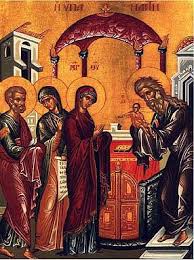
Candlemas
A transcript of the sermon preached for Candlemas 2012, at St. Paul's in Kewanee, Illinois (for the audio, click here):
 In the name of the Father and of the + Son and of the Holy Ghost.
Dearly beloved in the Lord, the birth of Jesus Christ our Lord, his manifestation in the flesh is a fulfillment of the word that was written by Moses: Let there be light and there was light.
From the very beginning, this was to be so: that while darkness shrouded the earth, nevertheless the Spirit hovered over the face of the deep. And the Spirit gave way to the word which proceeded and came out from the mouth of God: let there be light. And the world shrouded in darkness was enlightened.
This is the way of God. This is the way also, therefore, of the Gospel. This is how it works. The light shines in dark places and enlightens them all by itself.
This is what caused Simeon to exult and rejoice when the Child Jesus was brought into the temple on that great day, the day we commemorate this day, the fortieth day from his birth, the day he was presented in the temple. And with the song of the angels still resounding in their ears, Mary and Joseph now here Simeon’s exultation and exaltation of Christ, the One come as a light: a light to lighten the Gentiles and the glory of God’s people Israel
This is what it means that the world was shrouded in darkness and then was enlightened by the word of God. This is what it means: that without him we are lost. Our hearts, that is, are the places where the true and deepest darkness may be found. The heart of man, the darkened heart of man gropes after but can come nowhere near finding its Creator. We grope in the dark. We are lost, we are helpless, we are hopeless. We are sinful masses who have failed our Creator. The darkness is we ourselves: our hearts are darkened. Their foolish hearts were darkened, says the Apostle St. Paul, and he was not only referring to those who happen to be on the outside, but to all of us. Our hearts are by nature completely shrouded in darkness.
But thanks be to God that the Spirit of God hovered there, as the word was spoken over them, and the waters over which the Spirit hovered in the beginning, have become for us the waters of the blessed laver and font of Holy Baptism; and we have been brought into the light of Christ by the grace of his speaking: Let there be light. In him and only in him is light. And without him, and without his word, there is only darkness. We are lost, condemned, dead, enemies of God in ourselves. But Christ has come, as it were out of nowhere, and the light has enlightened the darkness, as it is written by the prophet Isaiah, the prophet perhaps that Simeon had in mind when he said his words. The prophet said, The people that sat in darkness have seen a great light. We sat in darkness; we have seen a great light.
But who gets credit for the seeing? You? Your eyes? They are useless without light. It is the light that enlightens the room, that gives sight to your eyes; and so also it is the Gospel and story of Jesus that gives light and salvation to our darkened hearts. So we find on Candlemas, the day on which we celebrate the light of Christ, we find that we have been enlightened entirely by the magnificent, unspeakable grace of almighty God.
This is the light of Christ toward which we also tend, toward which we are headed. I love the words of the Introit for a Requiem: Eternal rest grant unto them o Lord, and let perpetual light shine upon them. The idea that the dead in Christ are in perpetual light is very biblical, because God is light; and light emanates forth from him. The light of the Transfiguration emanated forth from him. The light of the glory that shown around the Bethlehem
The elderly Simeon was now unafraid to face death itself: Now let your servant depart in peace, he cries, unafraid; because he holds the source of light and life and salvation. So now we receive him here in this holy place, and it is therefore perfectly appropriate and right that we should sing the same words, that they should be echoed on our lips:
Lord, now lettest Thou Thy servant depart in peace—let come what may—because according to thy word mine eyes have seen thy salvation which Thou has prepared before the face of all people. A light, a blessed light, a holy light, an enlightening light, a dispersing of the darkness light. And the glory, the only glory, of God’s people Israel
Sunday, January 29, 2012
Tuesday, January 24, 2012
Sunday, January 15, 2012
Tuesday, January 10, 2012
Sunday, January 08, 2012
The Holy Family
On the First Sunday after the Epiphany, we consider the trial that beset the Holy Family, according to St. Luke 2:41-52. The sermon.
Sunday, January 01, 2012
The Circumcision and Name of Jesus
On a rare weekend in which a number of people attend mass both on New Year's Eve and New Year's Day, and the same propers are used, the opportunity was used to preach on two different aspects of the Circumcision and Name of Jesus. On New Year's Eve, the Circumcision, and on New Year's Day, the Name of Jesus.
Monday, December 26, 2011
Jesus Came for the Desperate and for the Frightened

The audio links for three Christ Mass sermons (Christmas Eve, Midnight, and Christmas Dawn) are here, here, and here. The transcript of the first is here:
In the name of the Father and of the + Son and of the Holy Ghost.
Dearly beloved in the Lord,
Consider the first people to whom the Lord appeared on the night of his nativity. There were two humble groups of people. The first group was the couple, Mary and Joseph. The other group were simple shepherds. A consideration of these groups and the fact that these were the ones whom the Lord chose in his mercy first to reveal himself provides abiding comfort and joy to all who find themselves in similar circumstances. For those circumstances are hardly the kind of circumstances to wish for on Christmas Eve when family and loved ones are near, with the warm and cozy feeling you get when everyone is nearby.
It was frantic for Mary and Joseph. They did not want to have to go from Nazareth all the way down south in the Bethlehem
So they had to take emergency measures, which for them meant finding a cave where cattle lately fed, in the cold and damp and dark of the night. And there and then was the birth of the Savior of the world. It was to Mary and Joseph in the midst of chaos and all things gone wrong that the Savior came. The son of Mary was born then and there
And now consider the shepherds, the humble peasants living in the field, keeping watch over their flock by night. The angel of the lord came upon them, and the glory of the Lord shone round about them, and they were sore afraid, which means they were terrified. Wouldn’t you be, if the glory of the Lord shone round about you? And so there they were, in the same cold night, in the same place, terrified out of their minds. It was to them also that the Savior of the world appeared.
And so, beloved, get the truth here of Christmas Eve. He comes to those who need him the most desperately, those who are in the most desperate of circumstances, those whose lives are the most torn apart, whether it be by hardship, calamity, grief, sorrow, fear. All the things that are capable tearing your lives into pieces mounted up against Mary and Joseph and the shepherds on that night and made it appear to their eyes as though all was lost. To them the Savior came, to rescue them who could clearly by no means have rescued themselves. They were sunk, they were lost, they were goners. No help for them. No room in the inn. No comfort for troubled shepherds. To them, as it were, out of nowhere, the Savior of the world comes.
And this shall be a sign unto you in the midst of your troubled lives, no matter how troubled and saddened and stricken they may be. Never lose heart. This is why Jesus says to his disciples that men should always pray and never to lose heart. Because he was born in a day when, of all times, one would have thought, it would have been appropriate to begin to lose heart. On the contrary, the timing was perfect; the night was just right. It was just the way God wanted it, that the Savior should be wrapped in swaddling clothes and laid in a manger, a feeding tough for sheep, or goats, donkeys, or oxen. This shall be a sign unto you: this is how it works; this is how he covers his glory.
This is how he comes also to you, to lay to rest for good whatever fears you might have like the shepherds, or whatever worries or fretting you might entertain like Mary and Joseph. He was in charge of that night from before its beginning, as we now know, as we now celebrate year after year. It was perfect. We know that now. But if you were there the first time, the first Christmas, you would not have seen in advance, you would have had to trust in the darkness that God cannot lie. So now learn from the blessed Christmas Gospel that he does not lie to his people. And when the night is darkest, and when the day is most troubled, and when death tears at your heart the most sourly, and when you are most sorely tempted to despair, remember this holy Gospel. He came to them to comfort them in the midst of their troubles, and to comfort you. For this is a sign also unto you. He is wrapped, he is covered, he is shrouded. His glory cannot be seen except for a brief moment in the Bethlehem
So tonight he also covers and shrouds his glory, in the simple words of this Gospel, and most especially in this blessed Sacrament, the Christ Mass, you can’t see his glory. You can’t see that he is Immanuel—God with us—here and now, but you know it. Beloved, you know this. You’ve been raised with this. Hold it dear and never let it go. The message of Christmas is that God is with us in the night, in dark, in the cold, in the cave, in the manger, in the Christ child over which the angel at just the perfect time sang, Glory to God in the highest, and on earth peace, good will toward men.
In the name of the Father and of the + Son and of the Holy Ghost.
Wednesday, December 21, 2011
St. Thomas
Did you think it was accidental that Thomas was away when Jesus came? Or that when he returned, he heard? Or that when he heard he doubted? Or that when he doubted he touched? Or that when he touched he believed? These things are not accidents, but providential: the mercy of God is found in Thomas' doubting: he placed his fingers into the bodily wounds of his Master, so that he might bring healing to the spiritual wounds of doubt in our souls. . . . The sermon.
Tuesday, December 20, 2011
Sermon on John, and Divine Mercy
St. Luke 1:67-80
And John’s father Zacharias was filled with the Holy Ghost, and prophesied, saying,
Blessed be the Lord God of Israel; for he hath visited and redeemed his people, and hath raised up an horn of salvation for us in the house of his servant David; as he spake by the mouth of his holy prophets, which have been since the world began: that we should be saved from our enemies, and from the hand of all that hate us; to perform the mercy promised to our fathers, and to remember his holy covenant; the oath which he sware to our father Abraham, that he would grant unto us, that we being delivered out of the hand of our enemies might serve him without fear, in holiness and righteousness before him, all the days of our life. And thou, child, shalt be called the prophet of the Highest: for thou shalt go before the face of the Lord to prepare his ways; to give knowledge of salvation unto his people by the remission of their sins, through the tender mercy of our God; whereby the dayspring from on high hath visited us, to give light to them that sit in darkness and in the shadow of death, to guide our feet into the way of peace.
And the child grew, and waxed strong in spirit, and was in the deserts till the day of his shewing unto Israel
This is a full transcript of a sermon preached December 20, 2011, at St. Paul
In the name of the Father and of the + Son and of the Holy Ghost.
Dearly beloved the Lord:
In these words of Zacharias, we learn the true nature of the ministry of John the Baptist. We might have been deceived by it, because what we hear in the accounts of John’s preaching and baptizing is that he was in the wilderness, that he was dressed in a way that is rather scary, and he calls out for repentance, for the kingdom of heaven is at hand. He chides and rebukes the Pharisees and will not baptize them. He appears to be a harsh man; as is fitting for the last of the prophets of the Most High God. They appeared at first to be harsh men as well, because the Most High God himself appears at first to be harsh, even as we learn from the Epistle to the Hebrews. Moses said that the sight was so terrible that he—even he—exceedingly feared and quaked. The God with whom we have to do is a consuming fire. The call to repentance ought to rattle our bones. So God’s approach is fearsome; and his prophets, last of which was John, appear at first to be fearsome, and are nothing but fearsome to those who will not repent.
But all Jerusalem was coming out to John to be baptized of him in the Jordan
And then we find John as he truly is, as he was prophesied to be by his father Zacharias, saying, And thou, child, shalt be called the prophet of the Highest: for thou shalt go before the face of the Lord to prepare his ways; to give knowledge of salvation unto his people by the remission of their sins, through the tender mercy of our God, whereby the Dayspring from on high hath visited us.
Those who came to John for divine mercy received it, because he came baptizing in the wilderness, and Baptism to give knowledge of salvation by the remission of sins. For that’s what Baptism does: it forgives your sins, it fills you with Christ the coming one. It brings to you the tender mercy of your God. This John baptizing in the wilderness was most especially showing forth the tender mercy of God and the visitation of the Most High. This is why his father exulted the first chance he got to speak, after he was struck mute, when he at first would not believe the words and tidings of the angel. But then, when his mouth was opened and his mouth was loosed and he spake praising God, what he said was this canticle: Blessed be the Lord God of Israel
So finally our understanding of the Lord God of Israel is not merely that he is a consuming fire, one that causes us to shake, but a Redeemer, a rescuer, a horn of salvation; himself a Child, who grew to be the one who would take away the sin of the world of the world, as John said, the Lamb of God. In him is the tender mercy of our God; and therefore in John’s preaching also preeminently, and in his baptizing, there is mercy and salvation, and the knowledge of life and light to them that sit in darkness and the shadow of death.
Fear God at first; and then be comforted by God at last. For he is merciful and kind, and washes his people in his salvation that they might stand comforted. And rejoice in everlasting life.
In the name of the Father and of the + Son and of the Holy Ghost.
Sunday, December 18, 2011
Drop Down, Ye Heavens, from Above
The Fourth Sunday in Advent. The final and best preparation for the coming of Christ, according to St. John the Baptist. The sermon.
Subscribe to:
Posts (Atom)


 Posts
Posts


