
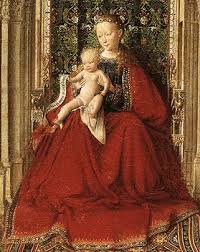
Rev. Eric Brown brought up a helpful discussion over at Four and Twenty Blackbirds on the semper virgo--the question whether the Blessed Virgin Mary remained virgin all her life--when he asked for the theological reasons and ramifications of it for those who believe it. He was not interested in proof-texts or other arguments for or against; he merely wanted to know what sort of significance it held in the theological scheme. So I chimed in. I decided to cross post my response here. If you want to get the full discussion on the matter, check there. But here's what I said:
Semper virgo ultimately has to do with coming to terms with the fact of the Incarnation. Here's what I mean: generally--though not in every case--it seems to obtain that among people who reject semper virgo there is a corresponding view that the BVM was nothing really unique. She is given the nod as the mother of Jesus, even (grudgingly) the mother of God, but these are merely names, and anyone can live with names.
What I find particularly helpful among medieval and early meditations on the Virgin--although there are excesses--is evidence of an eagerness to grapple with the reality of the miracle of Christ's conception in her womb. This eagerness is something I sense has been lost on us.
Luther similarly opines somewhere that there is great gain to be had from meditation on the term "Mother of God."
The fact is that Mary is unique. The miracle that happened within her was a sharp and singular break from the ordinary manner of human reproduction. This miracle was enacted upon her flesh, resulting in the Incarnation of God within her. She became the vessel for Him who holds heaven and earth, and it was of her flesh that He partook. This is something that really cannot be parsed and analyzed as much as it can be wondered at. At such moments we must become more inclined simply to revere and adore than merely to understand.
And this reality means that she is no ordinary vessel any longer. Something has really and verifiably changed: the nativity of our Lord is an incontrovertible verification of the miracle.
Since this is so, it seems to me that the whole Church--including, incidentally, Joseph--must set this vessel apart from all others on earth.
She is the Holy Grail. One does not use the Holy Grail to drink milk or beer.
I would think that of all people struck by this reality, Joseph would have to be first. Remember also doubting Joseph, how it was necessary for the intervention of an angel to correct him on this matter. Would he not become reticent about taking this vessel into his chamber for common use? No law forbade it, but that's not the issue: she has become the theotokos. That changes things, really and physically.


 Posts
Posts


