
Monday, May 31, 2010
The Holy Trinity
The Feast of the Holy Trinity grew out of a custom of using the Sunday after Pentecost for the "reconciliation of heretics." Hence Trinity Sunday is, in a way, an opportunity to point out false teachings against the Christian truth, in order to bring the world to the truth. The sermon.


Tuesday, May 25, 2010
God So Loved the World
The Gospel I preached this morning is actually appointed for Monday of Whitsun Week, but inasmuch as we didn't have mass then, I preached it today: (St. John 3:16-21), which includes the well-known "For God so loved the world, that he gave his only begotten Son, that whosoever believeth in him should not perish, but have everlasting life."
My guess is that most people don't know that this passage doesn't mean to say that God loved the world so much that he gave his Son, but rather that God loved the world thus and so, that is, God loved the world in this way.
His love is tangible and physical. It is not merely a feeling in his heart, but the expression of his willingness to give us everything that was his, and hold nothing back, all for us and for our salvation. For in giving his Son, who is in his bosom, this is what he did for the world.
The sermon.
Sunday, May 23, 2010
Pentecost
The Spirit which hovered upon the face of the waters in the beginning, which God breathed into the nostrils of man that he become a living being, that caused the lintels to shake when the angels in Isaiah's vision cried Holy, Holy, Holy is the Lord of Hosts, that issued forth from Jesus' mouth to call Lazarus from the grave, by which also Jesus spoke to still the sea and the waves, and that will cause the world to end with intense heat at the last day -- that same Spirit is given to the people of God in Holy Baptism, and is within you (in spite of yourselves). Surely you have nothing to fear. The audio of the sermon is here,as well as a musical treat spliced in, a German solo stanza of the Pentecost hymn sung by Peter Eckardt, and also as a voluntary, a beautiful rendition on organ of the same hymn, by the same Peter Eckardt.
Wednesday, May 19, 2010
The Glory of God in the Son and in His Disciples
In St. John 17:20-16 is this line: "And the glory which thou gavest me I have given them; that they may be one, even as we are one." What does this mean? Today's sermon.
Sunday, May 16, 2010
He Shall Testify of Me
The Spirit does not testify of us, but rather of Jesus; which is why so many do not want the Gospel, and some in fact persecute and would destroy. But to those who believe, the Spirit's testimony of Christ is the only thing we need. The sermon.
Tuesday, May 11, 2010
Rogation Tuesday
The Gospel for today (St. Luke 11:5-13) follows immediately after Jesus' giving of the Our Father. Thus the three loaves take on special significance, coming as they do right after 'daily bread', and remind us that in the Holy Supper we receive the Triune God. And the children in bed with the friend at midnight remind us of "all the company of heaven" who join us at the altar. And he who said he "cannot rise" and give, nevertheless did rise and give. So also Christ, who was dead, is risen, and now gives to his church as much as they need. The sermon.
Sunday, May 09, 2010
Rogate, the Fifth Sunday after Easter
The Gospel for today contains this: His disciples said unto him, Lo, now speakest thou plainly, and speakest no proverb.
What does this mean?
The Lord's speaking in proverbs, riddles, mystery, and the like was his wont since the beginning of the world, and throughout the Old Testament. Now that he is come in the flesh and has accomplished his work, his revelation is complete. Therefore also his name is complete, and we learn of him as Father, Son, and Holy Spirit.
And we learn of his love: the Son loves the Father as is evident on Good Friday; the Father loves the Son as is evident on Easter; and this love is the Holy Ghost, who is the one who brings us into unity with the Godhead through the Gospel. To think on these things is our defense against a troubled mind.
The sermon.
Wednesday, May 05, 2010
The Truth Shall Make You Free
Today's Gospel contains the saying, "ye shall know the truth, and the truth shall make you free," which is so often misunderstood. It has to do with sin, as Jesus himself says here. But the Jews misunderstood, and misspoke according to their own understanding of it, saying that they had never been in bondage. Had they forgotten Egypt? Or Babylon? Or even in their present, their subservience to Rome? How could they call themselves free in any sense? But such is the nature of rationalization. Neither do we want to hear of our slavery to sin, and rationalize it away. Repentance must lead to the word of Christ, whose redeeming sacrifice alone makes us free. The sermon.
Whatsoever He Shall Hear, That Shall He Speak
More on the Cantate Gospel, on which yesterday morning's sermon was preached again. Jesus' words "the Spirit . . . shall not speak of himself; but whatsoever he shall hear, that shall he speak: and he will shew you things to come" refer to the hearing and speaking of the apostolic ministers. In St. John's Gospel, the Spirit is used interchangeably with the apostles. He is sent, they are sent, etc. And Jesus breathed on them and said, Receive the Holy Ghost. So these words, "He shall glorify me: for he shall receive of mine, and shall shew it unto you" mean that when Christ is preached, the Spirit is at work glorifying Him. The sermon.
Sunday, May 02, 2010
Cantate Sunday
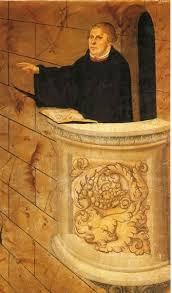
In today's Gospel we hear Jesus describing what is the task of the Holy Spirit in the proclamation of the Gospel: reproving the world of sin, of righteousness, and of judgment. First comes the conviction of sin by the preaching of the law: the world--and we ourselves--need its correction and accusations, to be convinced that we are indeed sinful and unclean. Second, the righteousness of Christ is put forth, by sharp contrast. For he was without sin in every respect. But third, the judgment is not upon us who are worthy of condemnation, but upon the devil; for the righteousness of Christ is his gift to his people. Thus they are washed in his laver of Baptism, their sins are drowned in his blood which they receive at the altar, and they are pronounced innocent by this holy Gospel. The sermon.
Tuesday, April 27, 2010
Whatsoever ye shall ask in my name
The enigmatic saying of St. John 16:23: ("And in that day ye shall ask me nothing. Verily, verily, I say unto you, Whatsoever ye shall ask the Father in my name, he will give it you.") refers, I believe, to the Holy Office into which these disciples are to be placed. St. Augustine believed that the words of this Gospel were actually spoken after the resurrection. He may be onto something, since Jesus said, "because I go to the Father," a reference, it would seem, to His ascension. After this, when the Holy Apostolic Office is inaugurated, these men will stand in Jesus' stead (a strong theme for this evangelist) and ask in His name, most especially, for the Holy Bread from heaven, the blessed Sacrament. The sermon.
Sunday, April 25, 2010
Jubilate Sunday
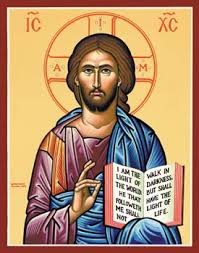
In today's Gospel (St. John 16:16-23) the phrase "a little while" is repeated seven times. So perhaps its faint echo was embedded in the recesses of the grieving disciples' hearts after Jesus died, keeping them from falling into utter despair until His appearance before them. So also do His people today sometimes find that He is absent or dead, and they grieve and sorrow and feel melancholy and depression, even though they should know better. But in His mercy He comes to us even as He returned to them, and says "Peace be unto you," most especially in the Holy Supper. He comforts His own; He does not leave them to their own devices; He returns after a little while. For He is truly risen from the dead, and comes to dwell with us in His Gospel and blessed Sacrament. The sermon.
Thursday, April 15, 2010
The Annunciation
Mary was full of grace, which means she was not full of personal merit. She was chosen because she was nobody.
So also have we been chosen and given grace, not in view of our merit and worthiness, but because of the love of God.
And as in the tiny space of Mary's womb a wondrous union with God occurred, so in also in us who receive the Holy Sacrament does this union occur.
The sermon.
Tuesday, April 13, 2010
The Humanity of Sympathy

The death of a dear loved one often leads people to ask why, especially when it is one so young and sweet, as was our dear Megan. Her picture-perfect marriage to our son was such a glad occasion only three months before she was diagnosed with cancer. Little did I know, when warning them in the wedding sermon that they would undoubtedly be facing challenges together in Christ, just how great and how near these challenges would loom. And so it is natural to ask why.
And yet, strange as it may seem, in the aftermath of funeral and burial, the question does not haunt us as it does those who have no hope.
The question in fact has many answers, first of which perhaps is this: all is vanity, saith the Lord. Weddings, as beautiful and happy as they are, can easily make us forgetful of this fact, and mislead us into thinking that it is in this life that we have hope in Christ. Certainly Megan did not think so. We look for the life of the world to come.
Further, when tragedy and death visit, I have no second thoughts about why I entered this holy calling; I have no doubt that this will also be embedded in the mind of my son when he receives his Holy Orders. For in the end, what can be more valuable for the world than the preaching of the Gospel? All flesh is as grass, and all the glory of man as the flower of grass. The grass withereth, and the flower thereof falleth away: but the word of the Lord endureth for ever.
And there's another thing. So many have expressed their heartfelt sympathy to us in recent days, leading me to think on the matter of sympathy. From the Greek syn + pathos, it means to suffer together, to share in the sorrow. And somehow, mysteriously, the sharing of sorrows makes them a bit easier to bear than for one who must sorrow alone.
Sympathy is also a very human thing. All kinds of people can sympathize. People who didn't even know you can sympathize. Sometimes even enemies have been known to set their enmity aside, if only for a time. Yet beasts do not sympathize. It is, I think, a residual part of man's creation in the image of God, who is Himself compassionate and kind to His people. Sympathy in itself, even if it isn't specifically Christian sympathy, is a good thing. It helps define us as the princes of God's creation.
Our thanks to all who have sympathized, and with that the reassurance that, as I intimated above, we do not sorrow as others who have no hope. For if we believe that Jesus died and rose again, even so them also which sleep in Jesus will God bring with him.
Christus resurrexit! Vere resurrexit!
Follow me
In St. John 21:15-19 Jesus asks Simon Peter three times if he loves Him, reminiscent of Peter's three denials and thus grieving and embarrassing him. So should we all be grieved and embarrassed at our failures to fear, love, and trust in Him above all things, or, as Jesus puts it here, "more than these." And yet Peter is right in replying that Jesus knows of his love for Him, for He knows all things. He knows that Peter's faith is born of the Holy Ghost and is therefore greater than his failures. It is a faith born of the triune God, which says thrice that it loves Him.
Therefore it never leads, but always follows Him. Much ado has arisen these days over "leadership" in the Church. The Church does not need leaders, she needs followers; men whose ministry will be beholden only to Him; and faithful who likewise will be willing to submit even to death while following Him. Like Peter, who at his own crucifixion requested that it be inverted, lest it be perceived as too bold a likeness to the Lord he loved.
The sermon.
Sunday, April 11, 2010
Thomas Sunday
The Sunday after Easter is Quasimodo Geniti, more popularly known as Thomas Sunday. How very like Thomas are we: we weren't there; we should have known; we require proof; Jesus in mercy provides us with all that we need. The sermon.
Saturday, April 03, 2010
The Vigil of Easter
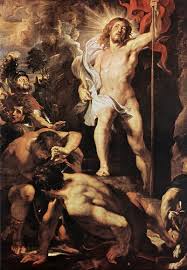
From darkness to light, we welcome the Feast of the Resurrection of our Lord at the Holy Easter Vigil. The sermon.
Friday, April 02, 2010
Good Friday
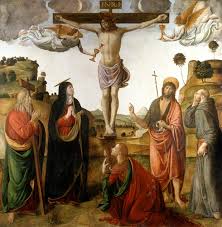
Of the seven last words from the cross, only the first, "My God, my God, why hast thou forsaken me" is recorded twice--both in Matthew and Mark. The significance of it cannot be overstated. He was earnest in asking, though it also fulfilled Scripture to ask. Why? is the righteous man's plea, and is part of his righteousness: is perfect faith. By this mystery we are granted a God who will never forsake us, though we deserve it. For he gained every right to pray, "Father, forgive them" for all, and "Today thou shalt be with me in paradise" to an individual. His "into thy hands I commit my spirit" shows perfect faith, and his "Behold thy son . . . behold thy mother" shows perfect dedication to duty even unto death. His "I thirst" pertains to his perfect fulfillment of the Scriptures, and his "It is finished" pertains to the perfect sacrifice. The sermon.
Subscribe to:
Posts (Atom)


 Posts


