
Thursday, March 25, 2010
The Wicked Hearts of Men
Today's Gospel (St. Luke 12:1-11) makes manifest the folly and wickedness in the heart of man: Judas, under a pretense of piety--does he really care for the poor?--he only cares about money, and is a thief, he chides Mary as an evildoer, when in fact she has done a good work. And consider Jesus' enemies: now they want to put Lazarus to death also, for no other reason than that Jesus raised him. Jesus raised him! The evidence of His glory is right before the eyes of these wicked men, yet they are blind. So the wickedness in your heart is manifest as well! Repent, with weeping and sorrow; and find now in Christ the redemption your soul needs. Learn with Mary the blessedness of His body given into death, and rejoice at the invitation to feast with Him. The sermon.


Faith and Sight
The difference between faith and sight is manifested in this Gospel (St. Matthew 26:57-68) as Jesus is spat upon, beaten, slapped, and mocked. Yet He says that the Son of Man shall come in glory. The sermon.
Wednesday, March 24, 2010
Jesus' Cry of Dereliction
Today's Gospel (St. Mark 15:33-39) contains the mystery of Jesus' cry: My God, my God, why hast thou forsaken me?" Like the mystery of Gethsemane, in which Jesus' will is seen in a sense to be different from His Father's (not as I will, but as Thou wilt), this mystery contains the complaint of the Righteous One: He must expect full deliverance, in accordance with the promise. This expectation is itself in keeping with His righteousness. Yet the Father abandons Him. Why? We know why (for the redemption of the world), yet there is here a divine conundrum of sorts, the heart of all that is mysterious.
But His abandonment is not eternal; He is not forsaken forever; weeping endures for a night, but joy comes in the morning, the morning of His glad resurrection.
So must we remember in the hour of our darkness that though His abandonment of us likewise brings grievous cries of "why?" yet He will resolve this and come back to deliver us. He must, for He conquered our enemies precisely in the cross. So His "loud voice" at His death was the roar or Judah's Lion. He gave the Spirit, which led the centurion and us to declare Him to be the Son of God.
The sermon.
But His abandonment is not eternal; He is not forsaken forever; weeping endures for a night, but joy comes in the morning, the morning of His glad resurrection.
So must we remember in the hour of our darkness that though His abandonment of us likewise brings grievous cries of "why?" yet He will resolve this and come back to deliver us. He must, for He conquered our enemies precisely in the cross. So His "loud voice" at His death was the roar or Judah's Lion. He gave the Spirit, which led the centurion and us to declare Him to be the Son of God.
The sermon.
Monday, March 22, 2010
Jesus in Gethsemane while the Disciples Sleep
Today's Passion Reading (St. Mark 14:32-42) contains some mysteries: why does Jesus pray alone, and leave his disciples to pray alone? Why does he first chide them for sleeping, then say, "Sleep on now, and take your rest," and then immediately, "Rise up, let us be going, behold, my betrayer is at hand"? And finally, how can Jesus' will be at odds with his Father's will? Even as man, his will is in perfect alignment with his Father's. So how can there be a "not as I will, but as thou wilt" in his prayer?
The answer to the third mystery may provide the other answers as well. Jesus is in a deep quandry: his Father's will as that he take the "cup" which the Father has prepared for him, but that cup is a cup of wrath (cf. Psalm 75). In order to do his Father's will he must become odious to his Father, for in this he takes upon himself what our sins have incurred. And thus his passion enables us to rest: he prays, his disciples rest; finally, he tells them to sleep on now, and then to rise up; a token of the blessed sleep of death in Christ, followed by resurrection.
The sermon.
The answer to the third mystery may provide the other answers as well. Jesus is in a deep quandry: his Father's will as that he take the "cup" which the Father has prepared for him, but that cup is a cup of wrath (cf. Psalm 75). In order to do his Father's will he must become odious to his Father, for in this he takes upon himself what our sins have incurred. And thus his passion enables us to rest: he prays, his disciples rest; finally, he tells them to sleep on now, and then to rise up; a token of the blessed sleep of death in Christ, followed by resurrection.
The sermon.
Sunday, March 21, 2010
Passiontide Begins
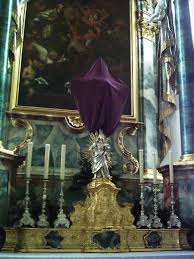
Today's Gospel (St John 8:46-59) sees Jesus and his enemies in fierce contest, in which Jesus finally tells them he is the I AM, God Almighty, in response to which they take up stones to cast at him, to kill him right then and there; and he hides himself from them.
So we also hide the images of him from today until Easter, remembering that we live by faith, not by sight, and that ours is a theology of the cross.
The sermon.
Saturday, March 20, 2010
What Is Most Valuable
The Gospel of the woman who anointed Jesus with ointment from the alabaster box sets before us a woman well worthy of emulation. She had this box in the first place probably in reserve for a special occasion or person, and by this act shows that she thought this occasion and this person to be most worthy, for this is Christ about to do the work of our salvation. So let us remember, at the threshold of Passiontide, to count consideration and meditation on Christ and His passion to be the most valuable of all our meditations, for His is our salvation, and His death is our life. The sermon.
Friday, March 19, 2010
St. Joseph, March 19
Today we turn aside for a moment from the Lenten trek to remember St. Joseph, Guardian of our Lord and Spouse of the B.V.M.
The sermon.
The sermon.
Thursday, March 18, 2010
He Was Innocent
Today's Gospel (St. Matthew 27:11-26), a portion of the St. Matthew passion, highlights Jesus' innocence and the fact that he, in spite of this, did not complain about the unfair accusations against him. This puts us to shame, who complain so easily about injustices committed against us, whether they come through error or malice.
Yet Jesus' passion out also fill our hearts with joy, since we know that he endured these things for our salvation. He was bruised for our iniquities, and his innocence covers our sin and shame.
The sermon.
Yet Jesus' passion out also fill our hearts with joy, since we know that he endured these things for our salvation. He was bruised for our iniquities, and his innocence covers our sin and shame.
The sermon.
Wednesday, March 17, 2010
I Am the Bread of Life
St. John 6 contemplates three miracles, of which the third is the greatest. The multitudes in the wilderness following Jesus call to mind the multitudes that followed Moses and were fed manna from heaven. This is the first miracle, a daily event for the Israelites. The second is greater, for here it is a Man who provides bread in the wilderness to 5,000, a multiplication of loaves. It shows this Man to be God.
The third is the greatest, toward which he wishes to prepare the hearts of his disciples when he says, "I am the Bread of Life." For this is not some mere figurative language, else why would the Jews be scandalized by it? "My flesh is bread indeed, and my blood is drink indeed." In this we are brought to see that the Blessed Sacrament is the greatest of miracles, for here is Christ, the Bread from heaven, given to us as bread to eat, in order to unite us with his divinity.
Wednesday's sermon.
The third is the greatest, toward which he wishes to prepare the hearts of his disciples when he says, "I am the Bread of Life." For this is not some mere figurative language, else why would the Jews be scandalized by it? "My flesh is bread indeed, and my blood is drink indeed." In this we are brought to see that the Blessed Sacrament is the greatest of miracles, for here is Christ, the Bread from heaven, given to us as bread to eat, in order to unite us with his divinity.
Wednesday's sermon.
Sunday, March 14, 2010
Rejoice!
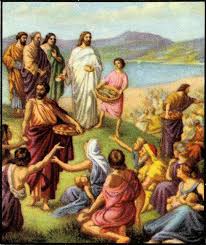
Laetare Sunday is our oasis in the midst of Lent, even as Jesus fed the 5000 in the wilderness, in today's Gospel.
Jesus' gentle treatment of his slow-to-learn disciples is on display here; he does not chide or rebuke them for failing his little test; he just shows them again, by feeding the multitude in the multiplication of loaves. So does he treat us in our weakness; he bears with us and helps us in our need.
He shepherds us even as he shepherded the multitudes, saying "Make the men sit down," for "there was much grass in that place," as it is written, "He maketh me to lie down in green pastures." As he sustained them all, so does he sustain us in our trek through the wilderness of life on earth.
But abiding joy governs the hearts of the faithful, even in the midst of this life, as in the midst of Lent stands Laetare Sunday.
It has also been called Rose Sunday, and in some churches there are rose colored paraments today. And just as a rose, the queen of all flowers, has thorns, so do joy and sorrow find themselves close together. But joy prevails, as does our anticipation of Easter during the midst of Lent; and ultimately our anticipation of the Day of days, when all sorrow shall fly away.
The sermon.
Thursday, March 11, 2010
Two Swords
The enigmatic saying of Jesus (in St. Luke 22:31-38) concerning two swords has been interpreted variously through the ages, most famously by the papacy during its ascendancy to support the idea that the pope grants the emperor the right to use his (the pope's) sword to govern, thus placing the church over the state.
Contextually we may see the existence of two swords here as a show of strength, certainly, but that strength is not to be used. When the high priest's servant's ear is cut off, Jesus rebukes the show of power, and goes humbly to his arrest, holding back the power at his disposal. So also, all the way to his death.
The two swords might therefore be seen to signify his two natures, and here, the fact that his divine attributes, though available, are not used: he goes to crucifixion because he wants to.
So also, he could help us at once in all our troubles, but instead uses them to strengthen us, as he did Peter: "I have prayed for thee, that thy faith fail not: and when thou art converted, strengthen thy brethren."
The sermon.
Contextually we may see the existence of two swords here as a show of strength, certainly, but that strength is not to be used. When the high priest's servant's ear is cut off, Jesus rebukes the show of power, and goes humbly to his arrest, holding back the power at his disposal. So also, all the way to his death.
The two swords might therefore be seen to signify his two natures, and here, the fact that his divine attributes, though available, are not used: he goes to crucifixion because he wants to.
So also, he could help us at once in all our troubles, but instead uses them to strengthen us, as he did Peter: "I have prayed for thee, that thy faith fail not: and when thou art converted, strengthen thy brethren."
The sermon.
Tuesday, March 09, 2010
Zaccheus
The tree which Zaccheus climbed (St. Luke 19:1-10) may be likened to the crosses we must bear in following Christ. But we ultimately come down with Zaccheus from those trees, and behold Christ in His tree, which is the cross. The sermon.
Monday, March 08, 2010
Become Like Little Children
In St. Luke 18:15-17, Jesus not only forbids His disciples from forbidding little children to come to Him; He insists that they must become like little children. So must we, and recognize out utter helplessness and dependency upon Him. Today's sermon.
Sunday, March 07, 2010
The Strong Man Overpowered

Today's Gospel (St. Luke 11:14-28) continues the prominent Lenten theme of Jesus against the devil, which was introduced at Lent I, Jesus in the wilderness. Today he casts out a devil, and intimates that He is Himself the Man stronger than the devil, who overpowers him and takes his armor and divides his spoil. This is the reason Jesus came to us: to defeat the devil our adversary.
And all evils we must endure--all troubles, sorrows, wickedness, and injustice--are things in which the devil's hand can be found, for he purposes always to do only evil and to make us miserable. And we find ourselves powerless against his wiles. But the good news is that Jesus is stronger, and although we remain powerless, we are rescued by Him and find ourselves through Baptism in His domain and under His protection; and therefore we need not despair in the face of any evil. His cross and resurrection means that He has given us the victory.
The sermon.
Saturday, March 06, 2010
The Widow and the Judge
Today's Gospel finds Jesus' parable of the widow's persistent pleas for a judge to avenge her; so the Church must ever pray in her afflictions, leaving vengeance to God. For to strike one who strikes you is to betray your own faith; to seek to get even is to deny that God is the Judge. So let us learn to be merciful and in so doing see that when the Son of Man comes, He shall find faith in the earth.
The sermon.
The sermon.
Friday, March 05, 2010
Casting a Sycamore Tree into the Sea
Jesus' words in St. Luke 17:1-10 present us with two religions. One is a religion of laws and rewards, the false religion of the Pharisees who were expecting rewards for their deeds. The other is the religion of mercy, by which we learn to forgive someone who sins against us even up to seven times in a day. The apostles said, "Increase our faith," and Jesus' reply was this: "If ye had faith as a grain of mustard seed, ye might say unto this sycamine tree, Be thou plucked up by the root, and be thou planted in the sea; and it should obey you."
What does this mean? Perhaps this is a reference to the false religion, coming up from generation to generation (like the roots of a tree), which leads all the way back to Eden and the tree of the knowledge of good and evil. From this tree springs the religion of laws and works, and its end is death. It must be planted in the sea, that is, drowned in Holy Baptism, that a new tree (a new religion) of mercy might arise, the tree of life and salvation.
The sermon is here.
What does this mean? Perhaps this is a reference to the false religion, coming up from generation to generation (like the roots of a tree), which leads all the way back to Eden and the tree of the knowledge of good and evil. From this tree springs the religion of laws and works, and its end is death. It must be planted in the sea, that is, drowned in Holy Baptism, that a new tree (a new religion) of mercy might arise, the tree of life and salvation.
The sermon is here.
Thursday, March 04, 2010
The Unseen Things of God
Today's Gospel (St. Luke 16:10-19) encourages us to remember that the unseen things of God are of infinitely higher value than those which are seen, things which are regarded highly in the sight of men. Moreover, Jesus gives this enigmatic logion: "If ye have not been faithful in that which is another man's, who shall give you that which is your own?" What does this mean? An unseen truth is that all that we are and have is a loan, something which really belongs to God. How we employ our gifts determines whether or not we are truly faithful (since faith is never alone without its works). Therefore this faith, in which we see a faithful use of our gifts, results finally in our participation in the glory of the Godhead, and in and through Christ it becomes our own. The sermon is here.
Wednesday, March 03, 2010
A Primer on Devils
In this evening's Gospel (St. Mark 9:17-29) Jesus gives us some rare insight into the world of devils and of faith; and we see the fine example set by the poor man who pleads with him with tears, "Lord, I believe; help thou my unbelief!" The sermon is here.
The Prodigal Son
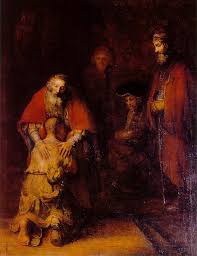
The kind heart of the father in this parable is directed both toward the returning prodigal and toward his brother; for both have strayed from their father. The prodigal went to a far country, but was received when he was yet on hill crest, long before setting foot on the front porch; and the brother, indignant over this, was also far from the thoughts of his father's heart, but the father went out to him and entreated him too. See how necessary it is to learn of our Father's heart toward us and our neighbors.
The holy liturgy helps us to do this, even as we see in this parable liturgical repetitions: first there is the prodigal's rehearsed confession, and then there is the father's repetition to his brother of the word, He was lost and is found, he was dead and is alive.
The sermon is here.
Monday, March 01, 2010
Why Bad Things Happen
Today's Gospel (St. Luke 13:1-5) provides us with Jesus' definitive answer to the question so many ask so often: why do bad things, disasters, horrors, sorrows happen? Why does God permit them? Are the people to whom they happen worse sinners? Jesus answers: no. But, he continues, unless you repent you shall likewise perish. So the tragedies of a fallen world are signposts from God that it is a fallen world, and we its fallen citizens. So we must all repent, to avoid an eternal plague. Today's sermon is here.
Subscribe to:
Posts (Atom)


 Posts
Posts


