Monday, October 02, 2006

TONIGHT, October 2 at 6:05: St. Paul's On the Air

"This is St. Paul’s On the Air: A radio program brought to you by St. Paul’s Evangelical-Lutheran Church in Kewanee, Illinois, where you know you’ve been to church: no gimmicks, no compromises, the talk is straight, and we feast on sacred things. Join us."

Those words will be heard after the choir sings the first stanza of "Saints and Martyrs and All Angels." And that's how our local radio show will debut tonight on the local Kewanee station, WKEI am radio, 1450 on the dial.

The voice continues: "Our moderator and discussion leader is . . . me: the Rev. Fr. Burnell F. Eckardt Jr., Pastor of St. Paul’s here in Kewanee, Illinois.

"I’m sitting with a small panel of listeners around a couple of microphones carefully positioned to help you get into the room with us and listen along.

"Our format for the show is catechetical. That means talking, listening, and discovering together. It’s a theological forum of the Church catholic, including a topical discussion of Apostolic doctrine, historic liturgy and rubrics of The Mass, the early church Fathers, The Reformation, and what’s on your mind today. We invite questions from the panel or from you. If you should have a question about anything having to do with the Christian faith, and you’d like to hear it discussed on this show, you may email it to us, using the email address pastor@stpaulskewanee.com, or write us at

St. Paul’s On the Air

109 S. Elm Street

Kewanee, IL 61443

"If you want to learn more about me or our church, log on at www.stpaulskeweanee.org."

The 25-minute show has two parts, first a Q & A entitled “Why?” which is named after our Sunday morning segment, called “Why,” a question beginning with the word “Why.” So, as I ask during Sunday morning class, “Does anyone have a Why?” The question on the air tonight will be "Why is worship so formal at St. Paul’s?"

The second segment is called "Searching the Scriptures" and will be dealing with Genesis chapter 1 tonight.

The show is already in the can, with a few minor glitches, but on the whole, it's an exciting new venture here. We'll see where it leads.

Saturday, September 23, 2006

Have Gown, Will Travel -- in hopes of teaching rubrics

Actually, I'm only taking a small carryon and a briefcase, due to airline restrictions, but I'm off to a doubleheader this week. First, it's off to the St. Michael Conference, moved this year for the first time from Detroit to Fort Wayne (Redeemer), to do a workshop on the rubrics for the celebrant at mass; and then the next day I wing through Chicago to a second itinerary to Denver, to attend the second annual Augustana Ministerium conference, where I must present a paper/discussion topic on the Historic Liturgy.

Both of these will be opportunities to plug our new St. Paul's Liturgical Institute. We're finally planning to do some hands-on teaching to make up for what has long been a serious deficiency at the Lutheran seminaries. Sorry to make this claim, but it's true. For too long, the bulk of training in how to do the ceremonies has been relegated to 'field work' parishes in the seminary neighborhoods. So neighboring pastors show the students how to do it. How did they learn? In field work, in their seminary days, by neighboring pastors. It gets pretty close to the blind leading the blind, when the seminary doesn't take the lead in these things.

It's been awhile since I've been there, so undoubtedly things have changed a bit, but not nearly enough, from what I hear out of recent graduates. Much more work is needed. Till then, the St. Paul's Liturgical Institute hopes to fill in the blanks.

First seminar, by the way, is in Kewanee, Illinois, from October 20 till November 3. To learn more, log on at www.stpaulskewanee.org (I sure hope the website is running ok; there are bugs in it still), or email me: eckardt@kewanee.org.

Tuesday, September 19, 2006

A Letter to the Editor

To the editor [of the Wall Street Journal]

Brent Stephens’ “Pope Provacateur” (9/19/2006) is certainly a welcome and refreshing rebuttal to the fanatics whose very manner of response sort of proves this pope’s point. In particular I found myself nodding agreement with his highlight of the Pope’s recognition that for Islam, God is utterly transcendent, “not bound even by his own word.” This is also the case, Mr. Stephens notes, for Protestantism. Here, however, a distinction is needed, and the Lutherans’ perennial defense against being lumped with the Protestants might be a particularly helpful ingredient in the faith-and-reason debate. It was John Calvin, roughly the contemporary of Martin Luther, who insisted on the utter sovereignty of God, characterized by a boundless and transcendent will. Pristine Calvinism bears some striking resemblance to Islam in this respect. Luther’s complaints against reason are not to be understood in the same way. His complaint was always against the exaltation of reason above what is revealed. The Pope’s argument sounds similar to that of St. Anselm of Canterbury, with whose famous declaration, “I believe that I may understand” Luther had no quarrel. Indeed when the Pope affirms that God must be bound by His word, he and Luther begin to sound very much alike. When God is divorced from His word, whether by Christians or Muslims, the danger of fanaticism always looms nearby. Since Calvin never saw that utter divine sovereignty and divine mercy were incompatible with each other, his thought never reached the radical stage of which it might otherwise have been capable. With Islam—although it certainly has its moderates—there is no mitigating notion of divine mercy at all to offset a transcendent and untethered divine will. The result can easily be, understandably, a very unruly mob of people. They’re acting the way they believe their God is capable of acting.

Monday, September 18, 2006

They're Here

Well, I knew this was coming. I told you so. We now have women ministers in the Missouri Synod. We just don't know it.

Here's how they did it. For the past thirty years, we've had the notion drummed into our heads that you can't ordain women, it's against the Bible, etc. So the SOW* folks decided to change their tactics in order to get the women pastors they always wanted.

Step one: convince everyone that ordination is an adiaphoron, an indifferent thing. Never mind that the Lutheran Confessions permit you to call it a sacrament, it's nothing more than a nice apostolic custom which we are free to take or leave. By the way, to any idiot who wants to retort that the Confessions do not require us to call it a sacrament, I'd like to say that I dont require it either: but in permitting such a designation, the Confessions are at the least affirming that it is an act of God. I wouldn't want to call an act of God an indifferent thing, would you?

But the SOW* crowd accomplished the first step, and now synodical types everywhere are convinced that ordination is really an adiaphoron, in spite of the fact that the Church has never designated someone as a minister without it.

Step two: reintroduce the historic diaconate, something the Synod should never have abandoned in the first place. I remember the haughtiness of the committee at the last convention which, when asked to consider an ordained diaconate, declared, oh no, ordination is a term reserved for pastors. Sure it is: as of 1853 in our synod alone. Talk about parochial!
Anyhow, now deacons are popping up here and there without ordination, and in fact the duties of a deacon, given for example in the Mid-South District, are pretty good ones (for which click here). Only trouble is, they're not ordained!

Oh, and this: there are females among them! Want to see one? Just check out the Mid-South newsletter, click on July-August, and go to page five (thanks to Fr. Larry Beane for the heads up on this). So now you have what I knew you were going to get: women in the ministry, women preaching, women administering the Sacraments. But it's all OK, because they're not ordained! You synodical types will just never get it, will you? You've been duped into this, and you never knew what hit you; the SOW* crowd can just give a quiet aside to its members: don't worry, ordination is no big deal anyhow. After all, we can even arrange for you to get your holy tax break, like we did for our "commissioned ministers"!

Now instead of this nonsense, can we please get serious about having a proper diaconate, complete with proper ordination? Like I said, they have a very nice explanation of what a diaconate does (and, unintentionally, why it should be an ordained diaconate), which, once again, you can see if you click here.

*Synodical Organization of Women, which actually doesn't exist as such, but is definitely a crowd of people who think the Biblical mandate against women preachers doesn't apply to them. They, like the NOW crowd, seek to impose their brand of feminism on the rest of us.

Wednesday, September 13, 2006

Octoberfest is Coming


Announcing . . .

The Eleventh Annual

Octoberfest

At St. Paul’s Ev.-Lutheran Church

Kewanee, Illinois

Sunday afternoon and Monday, October 8-9, 2006

Conference theme: Arranging Everything around the Blessed Sacrament of the Altar

This year we hope to have presentations by as many of the Gottedienst editors, live and in person, as we can get. Our editors include Dr. Burnell Eckardt, the pastor of St. Paul’s, who is the editor-in-chief, Dr. Karl Fabrizius, Rev. Aaron Koch, Chaplain Jonathan Shaw, Rev. John Fenton, and our newest associate, Rev. David Petersen. We expect most if not all of these men to be on hand to speak to participate.

The two-day event begins on Sunday afternoon at 5:00 p.m. with Autumn Choral Vespers, followed by a bratwurst banquet and awards ceremony (actually a bit of horseplay . . .). Monday’s schedule begins at 9:00 a.m. and includes Holy Mass at 9:30, followed by a series of seminars on the Sacrament and its centrality in the life of the Church. The day’s events end with Vespers at 3:00 p.m.

The conference fee, which includes three meals, is $25 per person, $40 per couple, or $15 per student. Children with parents free.


For more information, call (309) 852-2461.

Lodging: AmericInn, 4823 US Hwy 34. 800-634-3444

Aunt Daisy's B & B, 223 W Central Blv.d. 888-422-4148

Kewanee Motor Lodge, 400 S Main St. 309-853-4000

Super 8 Motel, 901 S Tenney (Rt 78). 309-853-8800

Days Inn, I-80 & Rt 40, Sheffield. 815-454-2361

Holiday Inn Express, I-80 & Rt 78, Annawan. 309-935-6565

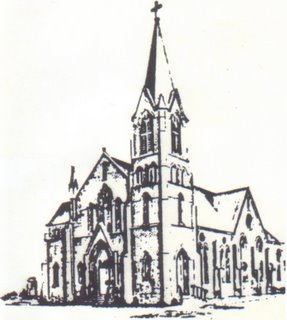
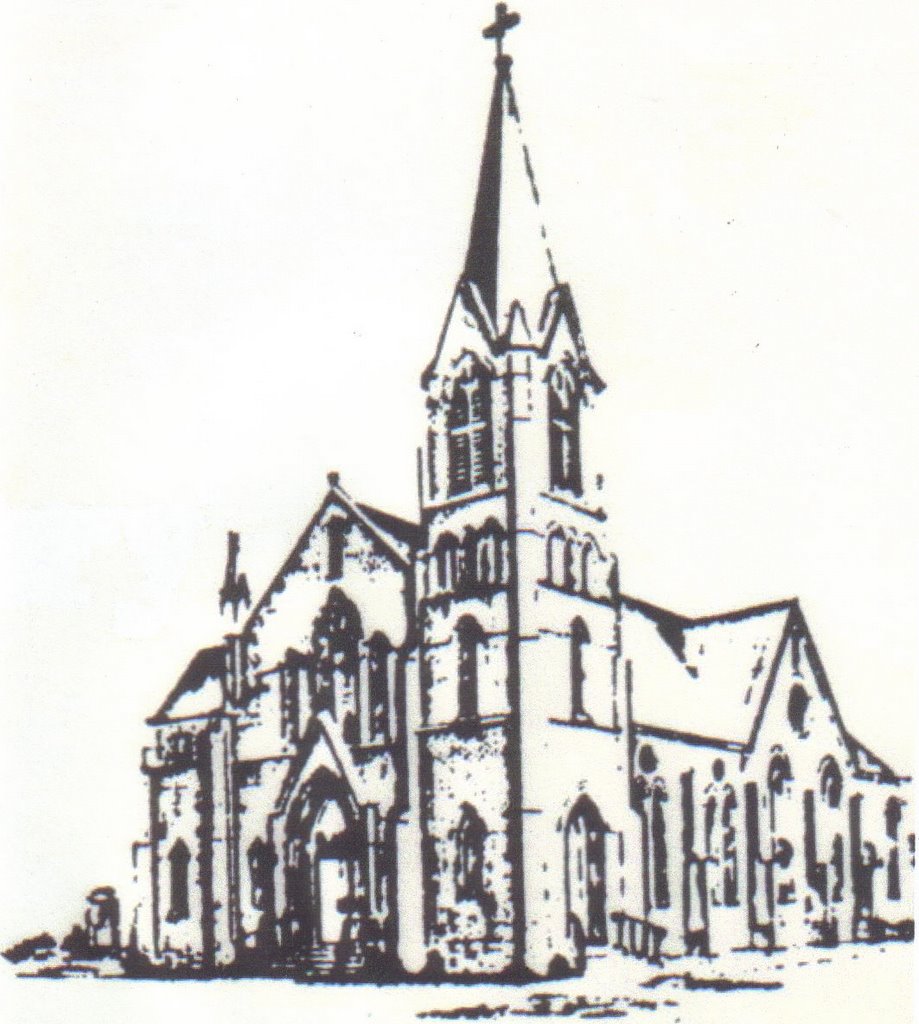
Directions: Take Illinois State hwy 78 to Central Blvd. (middle of downtown), and turn east. Go two blocks east on Central to the church. Red-brick Neo-Gothic building. No, it’s not incense you see rising from the vicinity; it’s bratwurst smoke…

To register, you may send us an email (Eckardt@kewanee.com)with the following information:

Title

Name(s)

Wife’s first name if applicable

Address

Email

Phone

Church

Sunday and Monday or Sunday only or Monday only


You could also reply to this blog and let us know, if you want, if you don't mind everyone in the world knowing that you're coming. But why not? It might encourage them. Then again, if you're shy, just send us your data as I suggested in the first place, in a separate email.


Saturday, September 09, 2006

Man's Best Friend


We finally did it. After a twelve-year hiatus without a dog, we have now increased our family size by one canine. We've had a fine cat in the intervening years, whose objections to this new brother are actually not as fierce as we might have expected, but I must say I disagree with Robert DeNiro's character in Meet the Parents. He said, as you may recall, that cats are better than dogs because they don't sell out, they make you earn their affection. Maybe so, but the thing about dogs is that they are loyal, as everyone knows. You can be the ugliest, craziest, or most neurotic, hated, or odd person in the world, and you dog will still love you. A dog's love is pure grace. I guess that's what I need.

So anyway, this little Labrador-retriever puppy is only four months old, and we're pondering a name for him. On top of the list right now is Reggie (the boys like this one, for Green Bay legend Reggie White). My favorite, Wyatt, was nixed. Also rans included Brett, Vince, and Lambeau. I would have liked Herb (my favorite Packer was Herb Adderley, back in the day). We also considered Luther, but that's a bit too common among Lutheran pastors. Also Bach, Mozart, and Johann. I sort of liked Laphroaig too, or Islay, or Malt (he is a brown dog), or simply Scotch. But I guess that would be better for a terrier.

Anyone with ideas may submit. We still haven't decided.

In other news, we have learned that we are to become grandparents sometime in late April or early May. Forgot to blog about that the other day. I guess that shows how much I am into instant gratification. Like, we have a dog right now, and the baby is still a ways off.

Thursday, September 07, 2006

A Double Life in the Blogosphere

I just spent a little while surfing through various blogs. Man, I am behind the curve. They're everywhere, and they are multiplying faster than rabbits on enzymes. Some of the blogs I saw are sharp and witty, and had me chuckling, thinking, gee, when I grow up I want to blog like that. The links are helpful ways to get you from blog to blog, but they can also blow you away, when you begin to see what looks like a vast blog-wing conspiracy seemingly seeking to take over the universe. There are blogs for everything. Naturally, I especially liked the one I ran into debating the virtues of Ann Coulter (she's my girlfriend, according to my dear wife, who seems to be all right with this).

What I find somehow stupifying is that there seems to be a lot of time and effort going into these blogs, some of which are updated daily. This is a veritable Phoenix which has arisen from the ashes of ruined newspaper empires. There must be millions who are writing and reading blogs. Reading too, because of the comments that get attached to the posts. Hey, is anyone reading this one? Ah well, I have been known to talk to myself on occasion.

So anyway, I'm wondering just how much time people are spending at this stuff, and I'm thinking maybe it's way too much. Or is it? The jury is out, I guess. On the one hand, it's so much fun to sit in front of the screen and type away, and not have to deal with life's real issues. It's a great escape, and in a certain respect one can easily live a double life in the blogosphere. I guess everyone knows there's cybersex too for those who want it, and nobody has to know. What a convenient place is the blogosphere for vices of all kinds, from the x-rated kinds to the garden variety, which, while tame by contrast, can be plenty harmful. Sloth is one the deadly sins, after all.

On the other hand, I suppose blogging can be a very good thing, as it's a means to reach people's minds and engage them in conversation. The blogosphere is very large. Anyone from Australia reading this? Or Siberia? Or the planet Pluto? As is usually the case with vices, the vice of overblogging is the abuse of a good thing.

And wouldn't you know it, here I go, spending too much time at this already. See how easily one can get carried away?

Tuesday, September 05, 2006

Something Missing?

Today I read an article about how the Pope went to see Veronica's veil, supposedly kept in a village about three hours from Rome. As I read the account, from a Roman Catholic source, I noticed the usual sense of wonder over miraculous things meant to verify the Christian faith. It is now thought by some that this 'veil' may not be the veil with which Veronica wiped Jesus' face as He was on the via dolorosa, but the headcloth, or "sweat cloth" found folded separately from the shroud in the empty tomb on Easter Sunday. There are some compelling data about the veil which contribute to the possibility that it is genuine, and yet, as is the case with most artifacts and relics the Church of Rome maintains, a thread of sensationalism running through the report. It's almost as if they're wanting these things to be true to bolster the Christian faith.

On the other hand, when I finished the article, I turned to some current events and doings among Lutherans, and I saw a completely different approach. Here, there was no concern at all about matters which have a direct connection to the life of Jesus, the matters reported in the Gospels, but rather, an abundance of emphasis on 'reaching people', evangelism, spreading the 'gospel', etc.

And I think that somehow, the attention given to relics and artifacts, while often bordering on superstition, is better, nevertheless, than attention given to 'sharing your faith'. The latter is too often subjective, personal, and devoid of any real Gospel content.

While certainly it is possible--and even laudable--to take the opportunity given to 'tell someone about Jesus', the emphasis on this telling has reached such a fevered pitch that, ironically, little about Jesus ends up being told at all. Rather, passing reference to who He is and what He has done might be made, while the heart of the telling is usually the invitation to receive Him, or to accept Him into your heart.

It's easy to criticize Rome for its superfluity of relics and superstitions. But I must say that there does seem to be at least a grain of goodness, if only a small one, in paying more attention to things which actually bear a better connection to Jesus than my own personal experience of His presence in my life.

Wednesday, August 30, 2006

The Shriven Woman

Tonight I'll be preaching on the Gospel from St. Luke 7, so I'll muse about it a bit in print. This woman kisses Jesus' feet and washes them with her hair, because she loves Him. She loves Him because she was forgiven much, as He says. So the false religion of this Pharisee is exposed. See, he had invited Jesus to dine with Him, no doubt because Jesus' high esteem among the people would likely help the Pharisee's own esteem with them. So it is with many who call themselves Christian yet know nothing of associating with sinners, to say nothing of repenting themselves. The Pharisee's indignance likely showed on His face, for when we are told that Jesus gave answer to what he was saying only within himself, we need not suppose that our Lord was drawing on His omniscience to know it; it was surely evident. There's a wonderful renaissance painting of this scene -- it might be a Rembrandt -- which shows the pomposity of the rich Pharisees decked out anachronistic nineteenth-century attire, while this poor ragged woman crawls up to Jesus' feet in their midst, making all the dinner guests uncomfortable. How little she has regard for appearances, thinking only of the overwhelming fact that she is in the presence of her Master; but how much they regard appearances, thinking so much of them that they miss the wonder of this occasion: their God is visiting them here, but they are too busy being indignant to notice.

Let all beware of false piety, and of keeping up appearances for their own sake. And let us follow the example of this public sinner, this harlot. She is unquestionably Mary of Bethany, as we are told in St. John 11 where this occasion is connected to Jesus' visit to her home. And when Jesus on another occasion visited Mary and Martha, it was Mary who sat attentively at Jesus' feet. This is not because she wanted to come off as pious, but just the opposite. She was utterly taken with Him, absorbed with Him, and her cup overflowed.

So must we all learn to be. Repent of false piety, and find your place on your knees before Jesus' feet. Wash them with your tears and wipe them with your hair; place yourself meekly beneath Him. For He forgives sins, another thing the Pharisees could not abide.

Become like Mary, then: close out the world and its Pharisaical masks. See only Jesus before you, and be overwhelmed: your God is He, claiming you, shriven sinner, for Himself, and forgiving all your sins.

Thursday, August 24, 2006

A Priestly Blessing

I trust Father Hollywood won't mind if I paste his belated reply to an earlier post here, as I find it most helpful, and something with which I heartily concur. Father H., I like the way you think:
"I realize this post is delinquent, I had meant to chime in earlier. A benefit of living in a heavily Roman Catholic area is that people seek out the blessins of the clergy. They "get" just what you're saying about the priestly blessing and the authority given to Christ's ministers.

"Strangers will come up to me and ask me to pray for them and bless them - even with my wife and son in tow (obviously, I'm not a Roman priest).

"This happens even more frequently when I'm in a cassock. To those who think the 'adiaphora' of clerical garb is useless, or even worse than that, negative - you need to put on a cassock and stroll around the neighborhood.

"Big guys with tattoos and little old ladies will come to you with pained looks on their faces and ask you to give them the blessing of the Lord Jesus - whom they know you represent and in Whose stead you stead.

"That's evangelism without a program, slogan, balloons, or even the letters 'TM' in fine print. "

Amen to that.

Monday, August 21, 2006

A Must Read

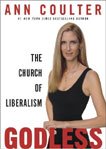
Say what you want about Ann Coulter, this latest book of hers is right on the mark, besides being an entertaining and fascinating read. No wonder the Left hates her so much: she is unafraid to call a thing what it is, and she does it with matchless wit and sauciness.

The reason I likewise am unafraid to recommend Godless: the Church of Liberalism is that it is not so much the reflection of a particular political stance as it is the exposing of scoundrels whose true aim seems to be the destruction of what is good (even of life itself, as in her arguments against the abortionists), and the rejection of the Creator (as in her case against evolution). This is not really a political book; it is true to its title, and it makes its case with remarkable skill.

And it does so with a flair which leaves no one wondering if Miss Coulter isn't just another fundamentalist bent on denouncing immorality for its own sake. She is too sarcastic and funny to be one of those; yet she argues with an aptitude which reminds me that she was once a lawyer by trade. She is a veritable Xena with words; even the New York Times has had to admit as much.

The first half of the book is methodical in its demonstrations of its claim that the Left is godless, so thorough that it left me feeling rather like St. Anselm's interlocutor blurting out that there is no possibility remaining of anyone issuing a rejoinder. Miss Coulter clearly subscribes to the doctrine of employing overwhelming force against the enemy, at least in literary terms.

About midway through the book she takes her case into the classroom, and proceeds to take on the myths promulgated by the behemoth teachers' unions in America. But this in itself provides a segue into the last, unexpected half, in which she dedicates several chapters to dismantling the myth of evolution.

She joins a host of recent writers who have begun to take on the scientific community's most basic Darwinian assumptions. In effect, the Scopes monkey trial is being revisited in our day. In fact, she exposes in particular that trial as the publicity stunt that it was.

But Miss Coulter is no slouch: she provides a tremendous amount of research and support for her claims, which is especially significant when she makes her case against Darwin and his heirs. And there is a difference between the way she battles the evolutionists and the way the fundamentalists have done so. She battles them on their terms, and exposes their tactics, while at the same time revisiting the case for Intelligent Design, unafraid to take on even a recent op-ed in the Wall Street Journal.

And she is not, contrary to popular belief, merely the conservative movement's answer to Michael Moore. Or if one insists on making the comparison, then only insofar as one can compare high class and savvy to juvenile follies.

But no mere reviewer can really make this point stick merely by saying it, which leads to the chief assertion of this review: Godless is a book that deserves to be read, by friend and foe alike. Anyone who chooses not to do so with a dismissive wave of the hand, as if to say, "Oh, that's just Ann Coulter, after all," has no business arguing against her case.

Wednesday, August 16, 2006

Back from Idaho


We're back from a fine vacation in Idaho, and I expect to be posting soon. One thing I mused on while seeing gorgeous tree-blanketed Rocky Mountains was this: These mountains must have been created by the Flood, in one day. The continents shifted west and caused the backwash of oceans to make a mountain range all along the west coast right down to the tip of the Andes. So the jagged edges of rock so prevalent there are a reminder of God's power and wrath. But the fact that many of them are now covered with trees ought to be a reminder that the wrath of God has now subsided, even as the flood waters themselves did. Indeed, what better natural symbol of mercy could there be than a tree? As the hymnist Fortunatus said it, "Faithful Cross! above all other, One and only noble tree! None in foliage, none in blossom, None in fruit thy peer may be. Sweetest wood and sweetest iron! Sweetest weight is hung on thee." So the image portrayed to knowing eyes by tree laden mountains is this: God's wrath has been put aside by the cross of our Lord Jesus Christ, and mercy abounds. No wonder the scene is so idyllic and calm.

Wednesday, July 19, 2006

One Voice for the Our Father

When in the old tradition of the Mass the Celebrant chanted the Our Father alone, he was not only following a venerable tradition which dates to the Early Church--which ought to be reason enough to retain this noble practice--he was also serving as bishop, the symbol of the unity of the Church. It is the same as when he chants the Collect alone (which, by the way, he should also do alone, especially in the Mass). It is called the collect because it is the prayer of the collected faithful: the many become one, expressed by the one mouth of the bishop.

Similarly, the Our Father is a prayer in which the many become one. The celebrant speaks for all the people, he performs a priestly duty here. But more importantly it is a Christic duty; in performing this duty he is serving as Christ for the people, presenting their petitions to God out of his own mouth.

After all, what gives us the right to call God our Father? Is He not the Father of Jesus Christ? And is not Jesus the only-begotten Son of God? God has no other children than Christ: he is the only. Then how is it that Jesus bids us to call God our Father? Surely, this can only be properly understood as an invitation for us to pray in Christ. We pray this prayer to God as though we were Christ Himself, for we are in Him. Heathen cannot rightly pray this prayer. It may not be prayed by one not baptized. This is why the pastor lays his hands on a child presented for Baptism, during the Our Father: it is an indication that the Our Father is here, in Baptism, being given to this candidate as a gift: he is being incorporated into Christ. Now, having been baptized into Christ, he is privileged to call God Abba, Father.

When at the High Feast of Salvation this principle is most properly expressed by the celebrant's utterance of this prayer alone. All Christians say this prayer day by day; but at the Altar, where the many become one, so the prayer fittingly becomes uttered by one voice, the voice of Christ. Christ employs the mouth of His servant, the celebrant, but the voice is most certainly His own. And thus all the people pray this prayer as one.

And it is said in immediate proximity to the Verba, the words of Institution, spoken also by the celebrant alone, in the stead of Christ.

Adapted from a 1999 article. Father Eckardt will be on vacation until mid-August. Comments will not be answered until then.

Monday, July 17, 2006

Wednesday, July 12, 2006

What's so Golden about the Middle?

It has become fashionable for church bureaucrats to instruct pastors with whom they have to do that while whacky, out-of-touch, loony "liberals" with their antichristian agendas are certainly not to be tolerated, there are also those who are too far out on the other side. The implication is that the middle is golden.

This is certainly true of some things. But the fact that it is gives no license for the maxim to be applied to all things.

There are not always two fringes.

Are we to say that someone who is way out on the 'no-integrity' fringe is no worse than someone who is way out on the 'too-much-integrity' fringe? Or what of someone who lies all the time. The other fringe would be someone who is too truthful. The reductio ad absurdem is not too hard to find.

So too, while there is certainly a too-loose fringe in matters of worship, that is, a kind of worship in which anything goes, and in which therefore everything becomes objectionable for those who truly want Christian worship, must there necessarily be a corresponding too-rigid fringe? "Rigid" of course is a nasty term by which bureaucrats like to refer to liturgists who take matters of worship with all gravity and seriousness. But is there a too-tight fringe? Actually if it be a truly opposite fringe to one that is too "loose," we must define "loose." I rather think it means casual, or lacking formality. But what's formality in worship? Is it not synonymous with reverence? Can one be too reverent? Ah, that is the real matter. Too reverent?

As in, have we shown Christ (whom we believe to be present) too much deference? Too much adoration? Too much worship?

I'm not sure the reference to the lukewarm in the Apocalypse is meant to apply to this, but I'd say it sort of fits. Sometimes the middle is not so golden.

New blog

Pastor Jonathan Naumann has a new blog called Engelein. Check it out here.

Thursday, July 06, 2006

Blessings?

One of the more amusing clichés which has evolved in recent years is that now-ubiquitous sign-off now used by many a clergyman, whether in print or in person: “Blessings!” Most commonly the expression begins “Blessings on your . . .” To this is added a word fitting the occasion. So to a pastor one might say, “Blessings on your ministry,” or to a committee, “Blessings on your conference.” To a pastor about to preach, “Blessings on your message” is heard. Or often the word stands alone, as in correspondence, being a closing salutation.

Whence this came is anyone’s guess, but what this historian finds amusing is the fact that it’s so often used by the kinds of Lutheran clergy who at the same time hold tenaciously to an acute anti-Catholic bias. They won’t wear a chasuble or intone the Introit, because that’s Catholic, but they’ll dispense blessings more freely than the most Tridentine of priests!

Among traditional Roman Catholics, the blessing of the priest is eagerly to be sought, and taken quite seriously when obtained. People would approach a priest for no other reason than to ask a blessing on their children (though not, I might add, while kneeling beside their parents partaking in the Sacrament of the Altar). The Vatican magisterium has routinely taught that a solemn duty of the priest is to dispense blessings upon his people.

I am, to be sure, rather vaguely averse to the usage, but not because of this. If anything, the thought that if taken seriously this cliché might offend against the anti-Catholic bigotry in our midst (one of the last acceptable forms of bigotry left in current society) would lead me to find it more, rather than less, palatable! I think Lutheran ministers would do well to consider the dispensing of blessings to be a solemn duty they too ought to do. These can take the form of brief benedictions when meeting with the bereaved, the sick, the distressed, or anyone who comes to meet with them. It ought to be done with the laying on of hands and signing of the cross on the forehead (and perhaps even with chrismating oil, as St. James says). In fact, the thought sits comfortably with me that this is really what is going on at the confirmation ceremonies of our young. The young teens are simply receiving the blessings of their priest as they enter adulthood. We already treat Lutheran confirmations as a sacramental kind of thing, even though we insist that confirmation is not a sacrament. But we routinely have parties whose celebratory mood can rival that of any bar mizpah or quinceñera. These youngsters are simply debutantes of a kind. Fine. So we do it in church, give them the blessings of their pastors, and think those blessings sort of sacramental, in a way. Perhaps a fuller consideration of this would be a fit topic for another day.

Regarding blessings in general, let us take them more seriously than as the bland, vanilla blubbering which the term “blessings” has come to be. Taken as it currently is, I would submit that to those who hear it, at best it generally communicates absolutely nothing, and at worst it gives an indication the one saying it must be a very holy person, that he speaks such a holy word. The latter inference is of course particularly odious to faith, because it smacks of the worst kind of pharisaism.

Let Lutheran ministers take the dispensing of blessings to be a solemn duty, then: they were ordained to do this, certainly, as Jesus said, “He who hears you hears me.” But let them never think that this can as well be something they ought carelessly dispense, in effect attempting to raise the estimation of others as to the degree of their holiness.

Adapted from a 1999 article.

Wednesday, June 28, 2006

Subduing the earth

At our house we've been working on the biggest project in family history. We're remodelling the bathroom, and since I'm a poor preacher (or so they tell me), it is necesssary that I learn to do as much of it as I can by myself. So in my spare time I've been a carpenter: tearing walls and floors apart, removing old tiles, old shower, old sink, etc.; building new structures here and there, putting up insulation, drywall, and cement board. We have a contracter working with me, but I've been doing things alongside of him every step of the way to reduce his hours of labor. We're finally to the point where most of the new light fixtures are in, new electrical, some new plumbing, new shower, new tub, new sink, and now stone tiles for the countertop and floor are going in. Soon we'll be finished.

Every night I go to bed sore, and wake up stiff. What a way to get in shape.

As I was mixing mortar today, I got to musing on the fact that this is what man does: he fills the earth and subdues it. He makes things do what he wants them to do. He puts them in order, by the sweat of his brow, even as Christ did in our redemption.

Jesus was a carpenter. That isn't just an interesting point of trivia. It means he was raised by Joseph in the trade of subduing the earth. This was a token of the redemption he would work.

Some say that the most godly places on earth are serene natural settings: sunsets, glaciers, canyons, mountains, etc. I think not. Raw nature can be beautiful, to be sure, but it generally needs to be tamed. It needs man. The most godly place on earth, therefore, has to be a place which man has crafted from the raw materials of earth. The most godly place on earth is a temple.

Destroy this temple, said Jesus, and in three days I will raise it.

The resurrected Christ has subdued the earth. It's something to appreciate when you're in the midst of a remodelling project.

Monday, June 12, 2006

Preaching and His Word

O preachers, it is written that the fear of the Lord is the beginning of wisdom.

That is, do not think yourself wise if you think that the beginning of wisdom is within you. Do you hold the Sacred Scriptures in the highest regard? Do you really believe them to be God’s Word? That all matters of faith and confession are to be answered by the Scriptures? Is Sola Scriptura your motto? And your preaching Bible-based and Christ-centered?

Then do not say that the Word of God needs to be made relevant. Do not they think of yourself as the filter through which the Word of God becomes relevant, something that the people can relate to, something they can take home with them. Do not think the sermon becomes the making relevant of the Word of God, putting it into terms we already understand. Do not make the preparation of a sermon an exercise in taking something from Scripture and using it to launch into something else, something you find easy to hear. So, for instance, a sermon on the multiplication of loaves and fish for the four thousand, ought to be more than a discourse on how able Jesus is to provide for our needs. The details are not to be omitted or ignored, or deemed insignificant. Take notice of the fact that the loaves and fish were brought by a boy who seems to have more faith than the disciples do. Consider how Jesus says to make the men recline where there was much grass, a link to the Twenty-third psalm. In short, do not preach something you find in the shrine of your heart to preach. Rather, preach something you have found in the words of the Gospel themselves.

If men would become true preachers of the Gospel, whose preaching they expect others to hold sacred and gladly hear and learn, they must learn how it is that their preaching will be in truth the very Word of God. It will not be if it is only something they themselves have dreamed up and hoped would be relevant. Rather, it must be something to which their hearts are held captive, which they have learned upon a musing on the sacred words themselves. For in this musing the Holy Ghost is present, as Luther also said.

But this will never happen among those who presume to know better than the words upon with they preach. Who for instance might find it too dangerous a thing simply to say, “If your right eye causes you to sin, pluck it out and throw it from you,” for they worry that someone might take them literally. What? They don’t think Jesus thought of that? They know better than He about what might be an ill-advised thing to say? Or again, they might find it too immodest to preach those texts which happen to refer to the breasts of a mother. That might be too embarrassing. Or they might think it too violent to preach about the bloody texts of murder or its vindications. What would the children think? Or—here it gets really dangerous—they might think themselves too loving to preach the imprecatory psalms. So what do they do with them? They simply ignore them, ignore those words of the Holy Ghost. For they know better, they are wiser than that, they know their people, and they know what might be offensive to them. So they say. And thus, beginning in ever so innocent a way, they listen to the shrines of their hearts over the written revelation of God.

O preachers, rather, be captive to that Word, not only in a general sense, but in very specific ways. If Scripture rebukes, you must rebuke; where Scripture becomes graphic you must be graphic; when Scripture is frank you must be frank.

Yet on the other hand, do not be more so than Scripture. Do not speak openly about shameful things which are done in secret; do not attempt a shock treatment on their hearers with a load of terms and descriptions Scripture does not use, especially when dealing with matters pertaining to sexual conduct and thought. Here, Scripture uses circumlocution very consistently. Thus, so must you. Though Scripture may be graphic about the battlefield, it is never graphic about the bedroom. You must follow suit.

You must, in a word, follow Scripture. You must not employ Scripture—Scripture must employ you. You must muse on the Scripture you are preaching, search it, rather than simply musing on what you might be able to say about it from your own resources. You must hear the Scriptures preaching to you first, and only then will you be ready to preach the Scriptures. You must regard especially the words of Christ as His sermons to you, and then when you yourselves preach, you will be preaching His sermons, His Word.

Simply, submit to His Word and fear it with a holy respect and reverence; that is the beginning of wisdom for preachers.

Adapted from a 1999 article.

Monday, June 05, 2006

A Meditation on Pentecost

According to Moses, Pentecost was observed by the bringing of new offerings, on the fiftieth (pentecoste) day after the day after the Sabbath following the Passover. So Jesus (our Passover) instituted the Holy Sacrament at twilight before His crucifixion, rested in the tomb on the Sabbath (Saturday), and rose from the grave on the day after. Fifty days later comes Pentecost on which a new offering is given, that is, a new age of the Spirit inaugurated. Today Christ's promise to His disciples is fulfilled, as the Holy Ghost, the Comforter, is sent to them, and they begin to declare His peace to the nations assembled there, on the fiftieth day from Easter. Pentecost, for seven is creation=s number, and forty-nine is creation squared, creation fulfilled; fifty then begins the age of the new creation. Sunday, because this is the third and final great Sunday of history, Creation Sunday being the first and Easter Sunday the second. So on Pentecost Sunday all is fulfilled, when the Spirit begins to give life to the Church through apostolic preaching.

--Burnell F. Eckardt Jr., Every Day Will I Bless Thee (Sussex, Wis.: Concordia Catechetical Academy, 1998), s.v. The Feast of Pentecost. To Purchase this book for $21.00, go pages 2-3 of the online catalog for the Concordia Catechetical Academy for ordering information, then click here for their printable order form to mail in your order (their online bookstore is currently under construction).